Written by the team at O2SOFT, a software development company. Writeouts publishes contributed articles without payment and removes promotional links.
Mobile applications have become an essential part of modern business growth. From online shopping and digital payments to healthcare and customer support, businesses rely on mobile technology to connect with customers and deliver convenient digital services. Mobile apps are no longer just an additional communication channel; they have become an important part of how companies operate, serve customers, and compete in the digital marketplace.
However, customer expectations are changing rapidly. People want applications that are faster, smarter, more secure, and easier to use. They expect smooth navigation, personalized recommendations, quick responses, and reliable performance across different devices. Businesses must therefore keep up with emerging technologies to remain competitive and provide better digital experiences.
In 2026, artificial intelligence, automation, cross-platform frameworks, and advanced security are shaping the future of mobile applications. Understanding these trends can help businesses make smarter technology decisions, improve customer satisfaction, and prepare for long-term growth.
Artificial Intelligence in Mobile Applications
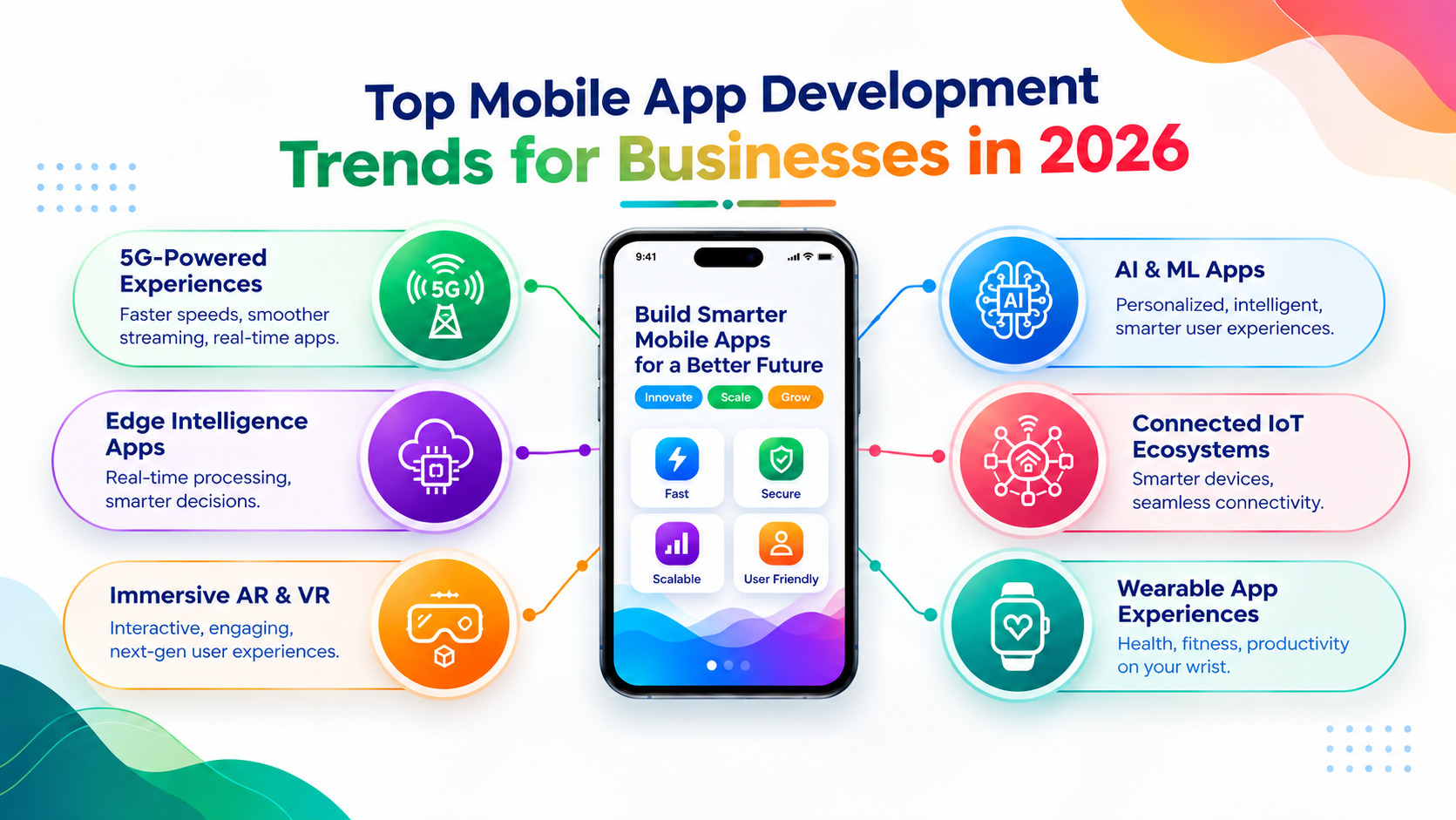
Artificial intelligence is transforming mobile applications by making them more intelligent and responsive. AI-powered features can analyze user preferences, provide personalized recommendations, automate customer support, and improve decision-making. These capabilities allow businesses to understand customer behavior and deliver services that match individual needs.
For example, shopping applications can suggest products based on customer interests and previous purchases, while financial apps can identify unusual spending patterns and provide useful insights. Healthcare applications can also use AI to support appointment management, analyze information, and improve digital patient experiences.
AI can further help businesses automate repetitive tasks, reduce manual workloads, and improve operational efficiency. Businesses exploring intelligent mobile experiences can benefit from modern AI development solutions to introduce automation and smarter functionality into their digital platforms.
AI Agents and Intelligent Automation
AI agents are taking mobile applications beyond traditional chatbots. Instead of simply answering questions, they can perform multiple tasks, interact with connected systems, and help users complete activities more efficiently.
For example, a travel application could help users compare destinations, organize travel plans, and manage bookings through an intelligent assistant. Similarly, an e-commerce application could help customers find products, check order information, and receive personalized recommendations.
Businesses can also use AI agents to automate repetitive workflows, organize information, and improve customer service. These intelligent systems can save time and provide faster responses while allowing employees to focus on more complex responsibilities.
The key is to introduce automation where it delivers real value while maintaining appropriate human supervision. Businesses should also consider data privacy, accuracy, and system integration when implementing AI-powered features.
Cross-Platform App Development
Businesses increasingly want applications that work smoothly on both Android and iOS devices. Cross-platform frameworks such as Flutter and React Native make this possible through shared development code. This approach can reduce duplicated development work, simplify maintenance, and help businesses reach wider audiences.
Instead of building completely separate applications for different operating systems, developers can reuse a significant portion of the codebase. This can make development more efficient and help businesses manage updates across multiple platforms.
Choosing appropriate mobile app development services can help businesses evaluate the right framework, application architecture, and development strategy according to their specific requirements.
However, cross-platform development is not suitable for every project. Applications that require advanced hardware integration, high-performance processing, or specialized platform features may benefit from native development. Selecting the right approach depends on the application's complexity, budget, performance expectations, and long-term goals.
Stronger Mobile Security and Data Privacy
As mobile applications handle more personal and financial information, security has become a major priority. Customers expect their information to remain protected when using digital services. A security issue can damage customer trust, affect business operations, and create financial and legal challenges.
Businesses should implement multi-factor authentication, encrypted communication, secure APIs, and regular security testing. Protecting sensitive information through appropriate access controls and secure data storage is equally important.
Transparent privacy policies and responsible data collection also help build customer confidence. Businesses should collect only the information they genuinely need and clearly explain how customer data is used.
Building security into every development stage can help reduce risks and strengthen customer confidence. Regular updates and vulnerability assessments are also necessary to protect applications against evolving security threats.
Personalized User Experiences
Customers expect applications to understand their preferences and make interactions more convenient. Personalization can include product recommendations, customized notifications, location-based services, and individual dashboards.
For example, an online shopping application can display products based on browsing history, while a fitness application can provide recommendations based on individual activity goals. These personalized features make applications more relevant and encourage customers to interact with them regularly.
A simple and intuitive interface also plays an important role in customer satisfaction. Complicated navigation, unnecessary steps, and confusing layouts can discourage users from continuing to use an application.
Investing in professional UI/UX design services can help businesses create applications that are easier to navigate and more enjoyable to use. Consistent design, accessible features, and clear navigation can improve usability across different screen sizes and devices.
5G and Faster Mobile Experiences
The expansion of 5G connectivity is creating opportunities for applications that require faster data transmission and responsive interactions. Businesses can benefit from improved video streaming, real-time communication, connected devices, and cloud-based services.
For example, video conferencing applications can provide smoother communication, while logistics platforms can receive and process tracking information more efficiently. Industries such as healthcare, education, and entertainment can also explore new possibilities through improved network connectivity.
However, applications should also perform well on slower networks. Not every customer has access to reliable high-speed internet. Optimizing loading speed, reducing unnecessary data usage, and maintaining responsive interfaces remain essential for reaching a wider audience.
Internet of Things Integration
The Internet of Things connects physical devices with digital applications. Businesses can use IoT technology to monitor equipment, manage inventory, track shipments, and control connected devices.
For example, manufacturing companies can monitor machinery, while logistics businesses can track deliveries through connected systems. Smart home applications can also allow users to control lighting, temperature, and security devices remotely.
Mobile applications provide a convenient way to access this information and manage operations from almost anywhere. Businesses can use real-time data to improve visibility, identify potential issues, and make informed operational decisions.
Reliable connectivity, device compatibility, and security are essential for successful IoT integration. Companies should ensure that connected devices and mobile platforms can communicate effectively while protecting sensitive information.
Cloud-Based Mobile Applications
Cloud technology allows mobile applications to access scalable computing resources, store information, and synchronize data across devices. This can support businesses that need flexible infrastructure and reliable access to digital services.
Cloud-based development can also simplify updates, support collaboration between teams, and reduce the need to manage all infrastructure locally. Businesses can increase computing resources as application usage grows and adjust their infrastructure according to changing requirements.
For example, an online marketplace can use cloud infrastructure to manage increasing customer activity during seasonal sales. Similarly, business applications can synchronize information across multiple devices, allowing employees to access updated data when needed.
Companies should carefully evaluate data protection, infrastructure costs, and backup strategies before adopting cloud services. Choosing reliable cloud solutions and monitoring performance can help maintain application stability and support future expansion.
How Can Businesses Prepare for These Trends?
Following every technology trend is not necessary. Businesses should select innovations that solve real problems and support their goals. Adopting technology without a clear purpose can increase development costs and create unnecessary complexity.
Start by understanding customer needs, reviewing existing systems, and identifying opportunities for improvement. Businesses should determine which features can improve customer experiences, simplify operations, or create new revenue opportunities.
Choose technologies according to project requirements, prioritize security, and test applications before launching them. It is also important to consider scalability, maintenance requirements, and compatibility with existing business systems.
Regular updates and customer feedback can help businesses identify usability issues, improve performance, and maintain a competitive digital presence. A well-planned development strategy ensures that mobile applications continue delivering value as customer expectations and market demands evolve.
Final Thoughts
Mobile app development in 2026 is focused on intelligence, personalization, connectivity, and security. AI, automation, cross-platform frameworks, and cloud technology are changing how businesses build and deliver digital services.
However, successful applications are not defined by the number of features they offer. Their real value comes from solving customer problems, improving everyday experiences, and supporting business objectives. Companies that embrace useful innovations and invest in reliable mobile solutions can build stronger customer relationships and prepare for future opportunities.
Another important consideration is scalability. As a business grows, its mobile application should be capable of handling increased users, expanding services, and changing market demands without compromising performance. Investing in regular updates, user feedback, and modern development practices can help organizations build applications that deliver lasting value.
Ultimately, businesses that focus on customer needs, reliable technology, and continuous improvement will be better positioned to succeed in the evolving mobile application landscape.
Edited by Rajat Chauhan. How articles here are written and edited.
0 comments
Sign in to join the discussion.
Loading comments…