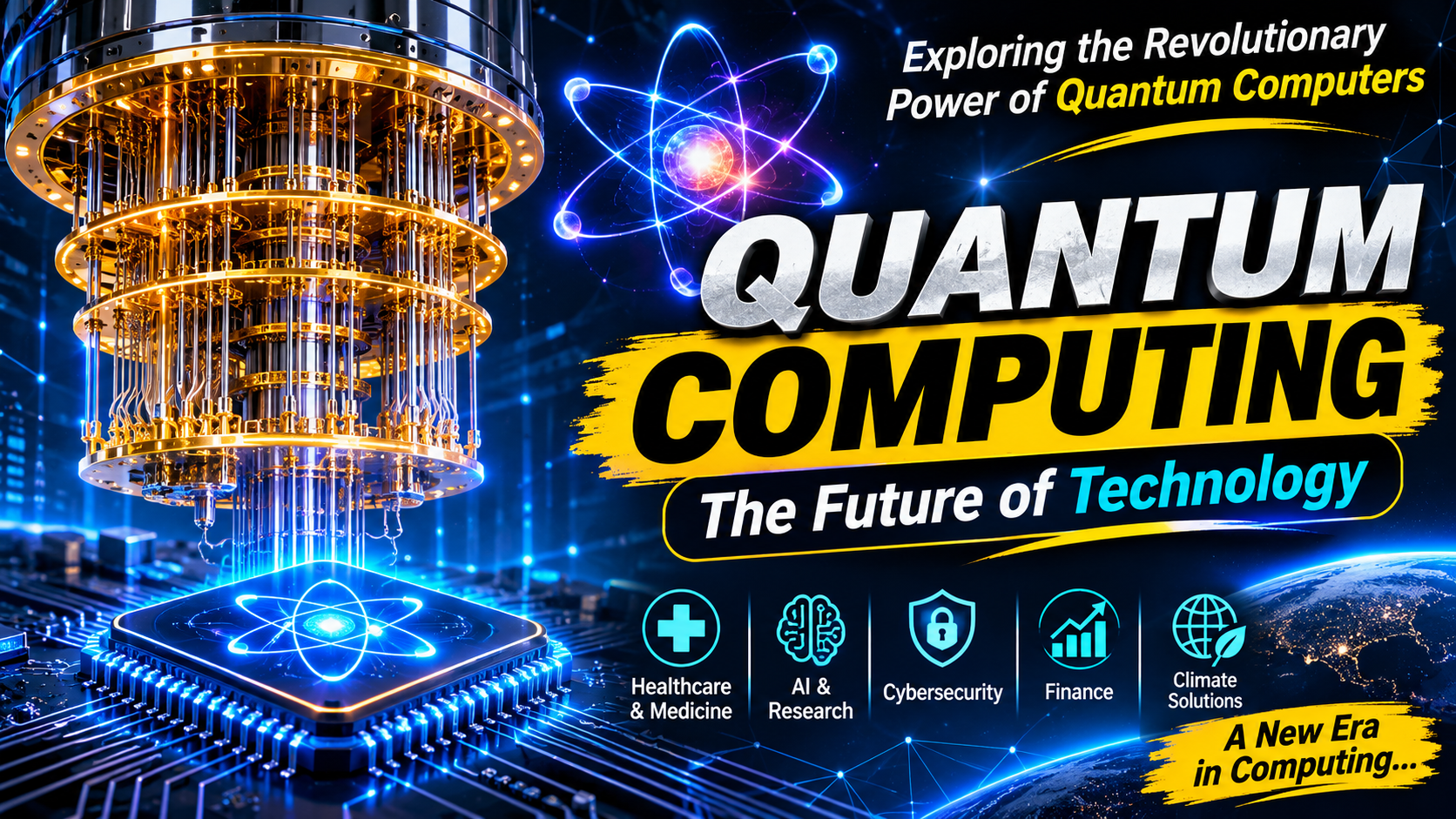
Technology is evolving faster than ever, transforming the way humans live, work, and communicate. From smartphones to artificial intelligence, modern innovations have changed almost every aspect of daily life. However, a new technology revolution is emerging that could take computing to an entirely different level: Quantum computing.
Quantum computing is an advanced field of computer science that uses the principles of quantum mechanics to process information. Unlike traditional computers, which use bits represented as 0s and 1s, quantum computers use quantum bits, commonly known as qubits. This unique approach allows them to solve certain complex problems much faster than conventional computers.
What Is Quantum Computing?
Quantum computing is a technology that uses the principles of quantum physics to perform calculations. Traditional computers process information using binary bits, where each bit represents either 0 or 1.
In contrast, quantum computers use qubits, which can exist in a combination of states through a property called superposition. Another important principle is entanglement, which creates strong connections between quantum particles.
These properties allow quantum computers to explore complex computational possibilities in ways that traditional computers cannot easily achieve.
How Does Quantum Computing Work?
Quantum computing operates through three important principles:
1. Superposition: A qubit can exist in a combination of 0 and 1 states until it is measured. This allows quantum systems to represent complex possibilities.
2. Entanglement: Two or more qubits can become connected so that the state of one is related to the state of another, even when separated.
3. Quantum Interference: Quantum interference helps strengthen the probability of correct computational results while reducing the probability of incorrect outcomes.
Together, these principles make quantum computing a powerful technology for solving specific types of complex problems.
Applications of Quantum Computing
Quantum computing has the potential to transform several important industries.
1. Healthcare and Medicine: Quantum computers could help researchers understand complex molecular structures, support drug discovery, and accelerate the development of new medicines.
2. Artificial Intelligence: Quantum computing may improve certain machine learning processes and help researchers develop more advanced artificial intelligence systems.
3. Cybersecurity: Quantum technology could influence modern encryption systems. A large enough quantum computer could break the public-key encryption in wide use today, such as RSA. That is why the US National Institute of Standards and Technology published its first three post-quantum encryption standards in August 2024, designed to resist attacks from quantum computers.
4. Financial Services: Financial institutions could explore quantum computing for complex risk analysis, portfolio optimization, and financial modelling.
5. Climate Research: Quantum computers may help scientists simulate complicated chemical and environmental processes, potentially supporting research into climate change and clean energy.
Challenges of Quantum Computing
Despite its exciting potential, quantum computing faces several challenges. Qubits are extremely sensitive to environmental disturbances, including temperature changes and electromagnetic interference.
This sensitivity can cause errors, making calculations difficult to perform reliably. Maintaining stable quantum systems also requires advanced equipment, specialized knowledge, and significant financial investment.
Furthermore, quantum computers are not designed to replace traditional computers in everyday activities. Their greatest value lies in solving particular problems that are difficult for conventional computing systems.
The Future of Quantum Computing
The future of quantum computing is promising. Technology companies, universities, and research organizations worldwide are investing heavily in quantum research and development.
As scientists improve quantum hardware, error correction, and software, these systems may become more practical and reliable.
In the coming decades, quantum computing could contribute to breakthroughs in medicine, materials science, artificial intelligence, and scientific research.
Conclusion
Quantum computing represents one of the most exciting developments in modern science and technology. Although it is still an emerging field with significant technical challenges, its potential applications are enormous.
It may not replace traditional computers, but it could become an essential tool for solving some of humanity's most complicated problems. Quantum computing is not simply an improvement in computing technology; it represents a new way of understanding and processing information.
Edited by Rajat Chauhan. How articles here are written and edited.
0 comments
Sign in to join the discussion.
Loading comments…