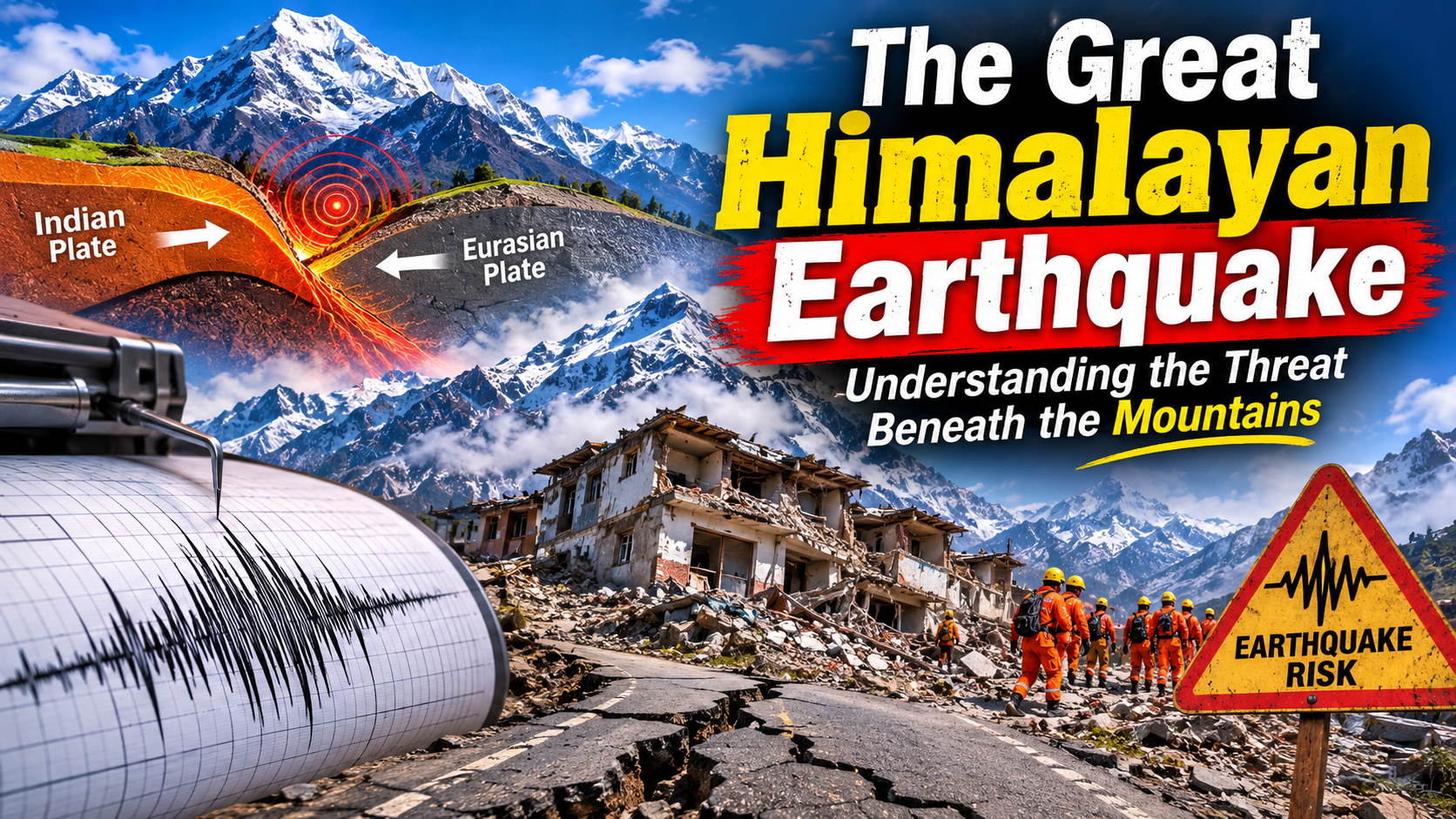
The Himalayas are among the most beautiful and geographically important mountain ranges in the world. Stretching across India, Nepal, Bhutan, Pakistan, and China, they are known for their breathtaking landscapes, biodiversity, and enormous geological significance. However, beneath their natural beauty lies a serious threat: the possibility of a major earthquake that could affect millions of people.
The Himalayan region is considered one of the most earthquake-prone areas in the world because of the continuous movement of the tectonic plates beneath the Earth's surface. Scientists have long warned that accumulated geological stress in certain parts of the Himalayan region could produce powerful earthquakes in the future.
Why Are the Himalayas Prone to Earthquakes?
The primary reason behind Himalayan earthquakes is the collision between the Indian Plate and the Eurasian Plate. Millions of years ago, the Indian Plate moved northward and collided with the Eurasian Plate, resulting in the formation of the Himalayan mountain range.
Even today, the Indian Plate continues to move northward and push beneath the Eurasian Plate. This movement creates enormous pressure along geological faults. When the accumulated stress becomes greater than the strength of the surrounding rocks, the energy is suddenly released, causing an earthquake.
This geological process makes the Himalayan region particularly vulnerable to large seismic events.
Historical Earthquakes in the Himalayan Region
The Himalayas have experienced several destructive earthquakes throughout history. Some of the most significant include:
1905 Kangra Earthquake: A devastating earthquake in Himachal Pradesh that caused widespread destruction and thousands of deaths.
1934 Bihar-Nepal Earthquake: A powerful earthquake that devastated large areas of Nepal and northern Bihar.
1950 Assam-Tibet Earthquake: One of the strongest recorded earthquakes in the region, causing extensive damage and landslides.
2015 Nepal Earthquake: A magnitude 7.8 earthquake that caused widespread destruction, casualties and damage to historical structures.
These events demonstrate the destructive potential of earthquakes in the Himalayan region.
Potential Impact of a Great Himalayan Earthquake
A major earthquake could have serious consequences for millions of people living in the Himalayan states and surrounding regions.
Buildings, roads, bridges, railway lines and communication networks could suffer extensive damage. Remote mountain villages might become isolated because of landslides and blocked roads.
Hospitals, schools, and emergency facilities could also be affected, making rescue operations difficult. Additionally, earthquakes can trigger secondary disasters such as landslides, avalanches, and flooding caused by damaged dams or glacial lakes.
Cities such as Shimla, Dehradun and Dharamshala, and parts of the Kashmir region, face high seismic risk.
Can Science Predict a Himalayan Earthquake?
Modern technology has improved earthquake monitoring significantly. Scientists use seismographs, GPS instruments, satellite observations, and geological surveys to study tectonic movements and identify areas where stress is accumulating.
However, predicting the exact date, location, and magnitude of an earthquake is currently impossible.
Scientists can identify regions with higher seismic risk, but they cannot provide an accurate warning months or years in advance.
Earthquake early-warning systems can sometimes provide a few seconds of warning after an earthquake begins, allowing people to take immediate protective action.
How Can We Prepare?
Preparedness is one of the most effective ways to reduce earthquake-related damage and loss of life.
Buildings in earthquake-prone areas should follow appropriate earthquake-resistant construction standards. People should also understand basic safety measures, such as dropping to the ground, taking cover under sturdy furniture, and holding on until the shaking stops.
Emergency kits containing drinking water, food, medicines, flashlights, batteries, and first-aid supplies can be extremely useful.
Governments and local authorities must also invest in disaster management training, public awareness campaigns, and stronger emergency response systems.
Conclusion
The Great Himalayan Earthquake represents a significant natural hazard for millions of people living across the Himalayan region. The continuous collision of tectonic plates makes this mountain system geologically active and vulnerable to powerful earthquakes.
Although scientists cannot predict exactly when a major earthquake will occur, research, modern monitoring technology, earthquake-resistant infrastructure, and public awareness can significantly reduce its impact.
Understanding the risks beneath the Himalayas is an important step toward building safer and more resilient communities for future generations.
Edited by Rajat Chauhan. How articles here are written and edited.
0 comments
Sign in to join the discussion.
Loading comments…