The best coding kata sites in 2026 are Codewars for ranked daily practice in 55+ languages, Exercism for learning a language with free mentoring, and cyber-dojo for classic test-driven katas with no account. Edabit and CodinGame also run your code before you sign up. LeetCode and HackerRank are interview trainers, not kata sites. Project Euler and Advent of Code are puzzle sets for any language.
We checked all ten on 31 October 2026 from a home broadband connection in Delhi, signed out of every site, and tried to run code on each (the method is in How this was checked). Below: what a kata is, which sites let you practise without an account, what each costs, and which to pick for beginners, test-driven development or interviews.
The best coding kata sites at a glance
Site | Best for | Free? | Runs code signed out? | Languages |
|---|---|---|---|---|
Ranked daily practice, community katas | Yes; Codewars Red is $5 a month | No: reads yes, Test and Attempt need an account | 55+ (58 listed, 29 stable) | |
Learning a language properly, mentoring | Yes, "100% free, forever"; Insiders is a $10 donation tier | No: reads yes, solving needs a free account | 85 tracks | |
Classic TDD katas, pair and group practice | Free for non-commercial use; companies buy a licence | Yes: tests ran in our session with no login | 42 languages, 61 exercises | |
Tiny beginner drills with hints | Free account | Yes: our answer passed Check without one | 8 | |
Puzzles with a game on screen | Free | Yes: "Continue without an account", then play test cases | Python 3 default; many more in the IDE | |
Interview problems | Free tier; Premium $39 a month or $299 a year | Not tested: its bot check blocked our browser | 20+ | |
Structured topic tracks, certificates | Free for practice | Not tested: its edge blocked our browser | Many | |
Maths-heavy problems | Free | No code runs on the site; you submit an answer | Any (114 used by members) | |
A December puzzle a day | Free; AoC++ is a donation | No code runs on the site; you submit an answer | Any | |
Katas to run in your own editor | Free | Nothing runs; they are descriptions | Any |
"Runs code signed out" is what we actually did: open the site in a fresh browser with no cookies, pick an exercise, and press the run or check button. The details of each test are under the site, and the method is in How this was checked.
What is a coding kata?
A coding kata is a small programming exercise you repeat to improve technique, the way a karate kata is a form repeated many times. Dave Thomas coined the term on codekata.com, where he writes that "a kata is an exercise in karate where you repeat a form many, many times, making little improvements in each. The intent behind code kata is similar." His site lists 21 of them, from Supermarket Pricing to Simple Lists.
The point is practice away from a project. Thomas's argument is that developers "do our practicing on the job, and that's why we make mistakes on the job." A kata gives you time without interruptions, a small problem, and feedback each time you try it. Codewars borrowed the word for its challenges, and its docs credit "Dave's version of the concept" from The Pragmatic Programmer.
Two kinds of site use the word today:
Kata platforms run your code in the browser against tests: Codewars, Exercism, cyber-dojo, Edabit, CodinGame.
Kata catalogues describe an exercise and leave the editor to you: CodeKata, Kata-Log, the Samman Coaching descriptions, the Coding Dojo catalogue.
Interview sites such as LeetCode and HackerRank are a third thing. Their problems are timed algorithm questions with hidden tests, closer to an exam than a form you repeat. They are on this list because every search for kata sites turns them up, and because some readers want exactly that.
1. Codewars: best for ranked daily practice
Codewars, often typed as "code wars", is the site most people mean by "coding kata". Each challenge is a kata, you earn rank and honour for solving them, and the community writes the katas. On 31 October 2026 its homepage said "55+ programming languages", "12K+ Kata created by our community" and "1M+ Kata completed every month".
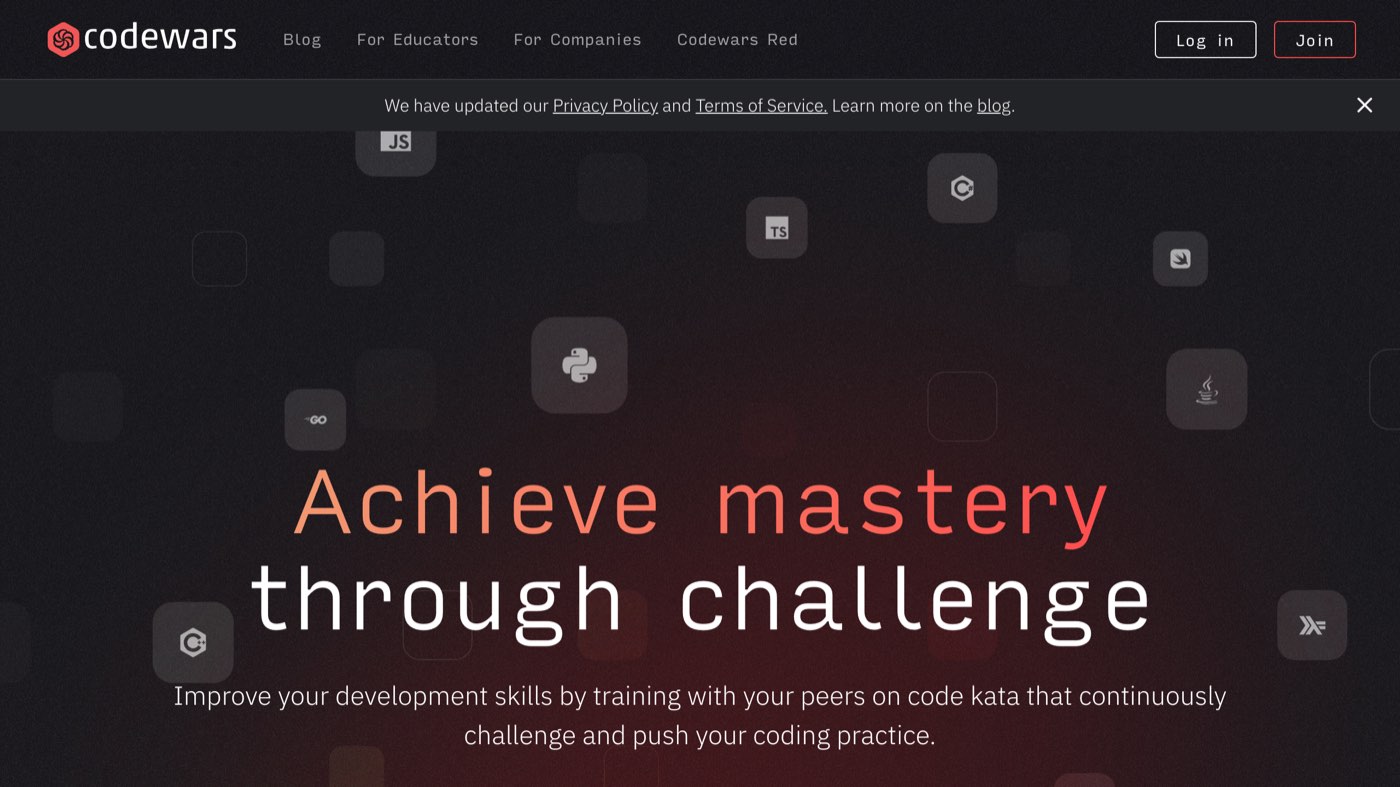
codewars.com on 31 October 2026 from Delhi, signed out.
The ranks come from martial arts. The Codewars docs explain that there are two classes, Kyu and Dan, with eight levels each: you start at 8 kyu, climb to 1 kyu, then move to 1 dan and up to 8 dan. Each kata carries the rank of its difficulty, and the score it awards grows fast. The docs' table gives 2 points for an 8 kyu kata and 1,097 for a 1 kyu one.
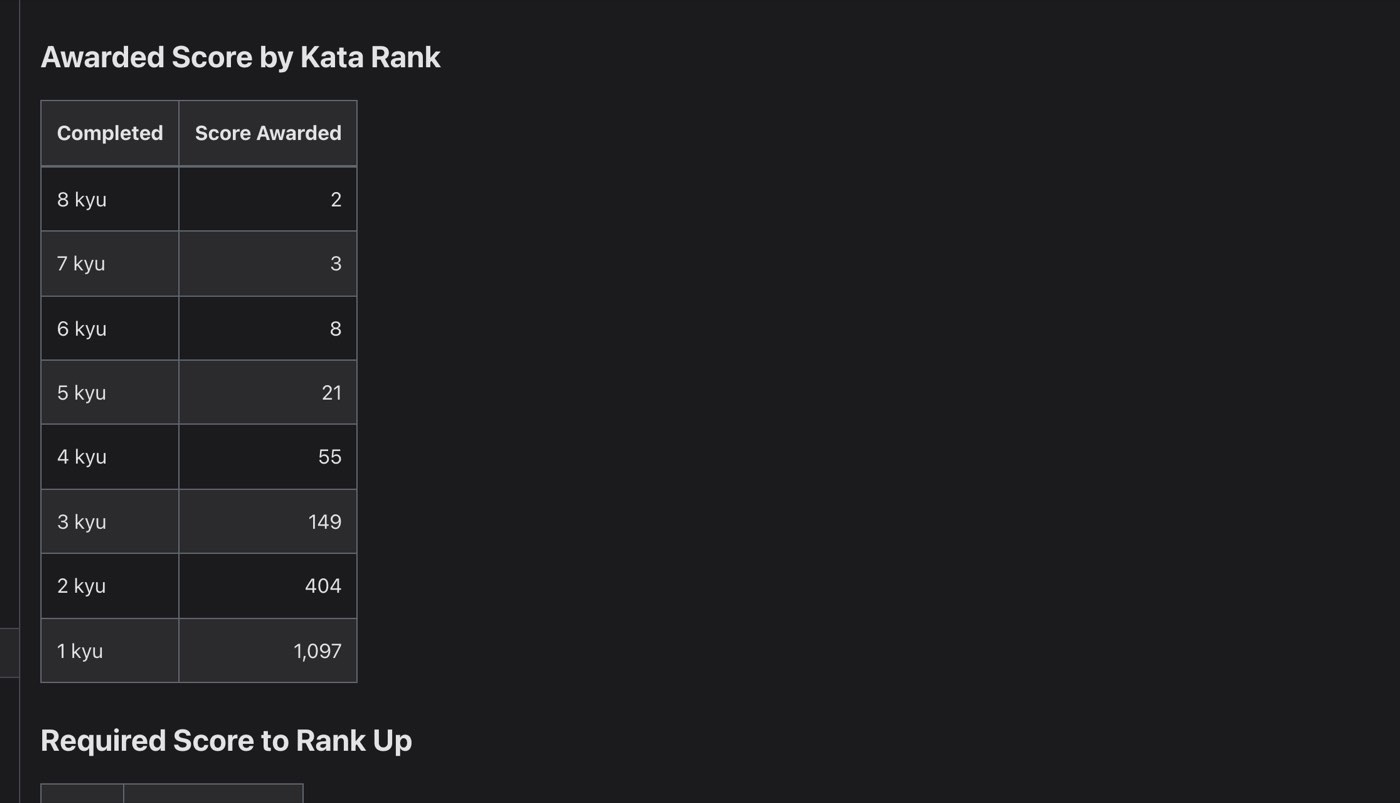
The score table from the Codewars docs, 31 October 2026: a 1 kyu kata is worth about 550 times an 8 kyu one.
Ranking up takes 20 points to reach 7 kyu, 643 to reach 4 kyu, 13,147 to reach 1 kyu and 35,759 to reach 1 dan, by the same page. Completing a kata counts once towards your overall rank, but each extra language you solve it in counts towards that language's rank. Honour is separate: it tracks activity and contribution, such as authoring katas, translations and up-voted solutions.
The language list is longer than the "55+" on the homepage. The docs' languages page listed 58 on the day we checked, 29 marked Stable and 29 Beta. Stable ones include Python 3.8 to 3.11, JavaScript on Node up to v22.x, Java 8 to 21, C#, C++, Go 1.24, Rust 1.86, Kotlin 2.1, TypeScript 5.7, Swift 6.0 and SQL on SQLite and PostgreSQL. COBOL, Fortran, Prolog, Solidity and RISC-V assembly are in beta.
What you can do on Codewars without an account
You can read any kata and see its starter code and sample tests. We opened the 8 kyu kata Multiply, which had been completed 5,573,820 times, 1,608,375 of them in JavaScript. The editor loaded with the runtime set to Node v22.x. The Test and Attempt buttons did not appear until sign-in, so you cannot run code as a visitor.
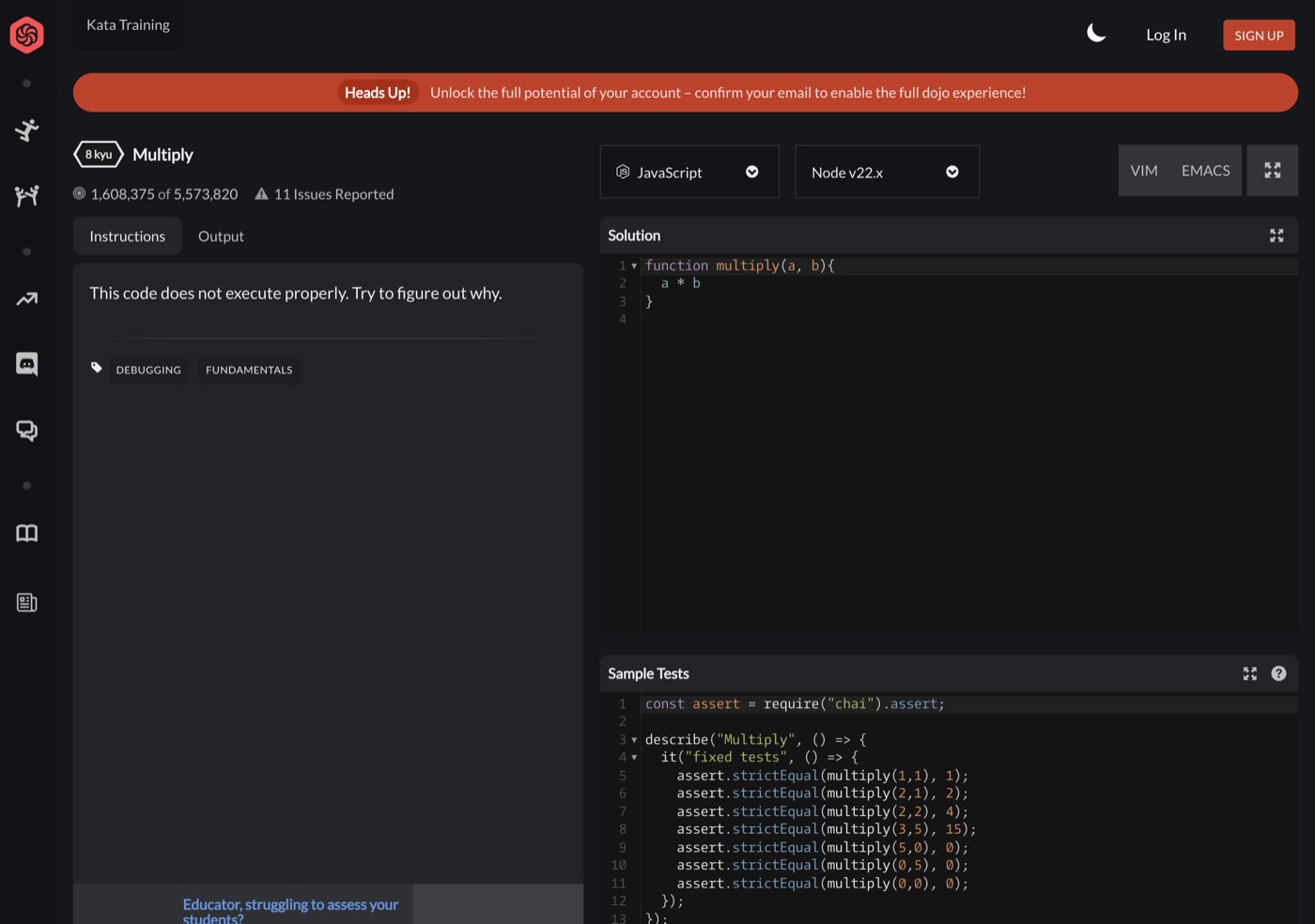
The Multiply kata (8 kyu) on Codewars, 31 October 2026, signed out. The instructions, starter code and sample tests load, but the Test and Attempt buttons only appear after you sign in.
The kata's own stats page says it was created on 28 September 2012 and that 5,737,475 warriors have trained on it. Codewars itself was founded in November 2012 by Nathan Doctor and Jake Hoffner, per Wikipedia. The site's footer now reads "© 2026 Andela. All rights reserved. Built on Qualified.io", so the assessment company Andela owns it.
Is Codewars free?
Yes. Every kata, rank and language is free with an account. The paid tier, Codewars Red, adds enhanced statistics, an ad-free experience, peer comparison, beta features and a profile badge. The subscription page showed $5 billed monthly, $24 every six months or $40 a year, in US dollars, as loaded from Delhi.
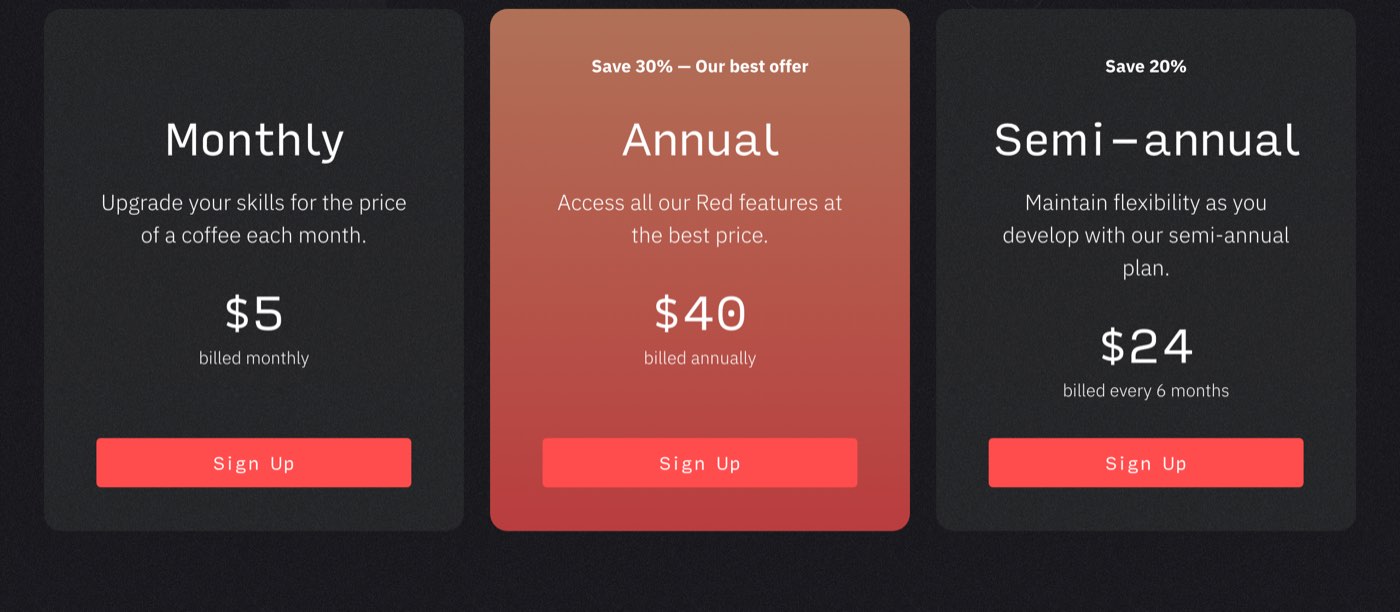
Codewars Red prices on 31 October 2026, loaded from Delhi: $5 a month, $24 every six months or $40 a year, in US dollars.
Pick Codewars if you want a habit: one kata a day, a visible rank, and other people's solutions to compare with your own after you solve each one. Its weak spot is quality control. Katas are community-written, so a few are badly specified; the Multiply page alone listed 11 reported issues.
2. Exercism: best for learning a language with mentoring
Exercism is a non-profit practice site built around language tracks and volunteer mentors. Its homepage on 31 October 2026 read "Explore and get fluent in 85 programming languages" and "Over 8,763 coding exercises", and repeated, three times on one page, that it is "100% free, forever". The nav still said "Upskill in 65+ languages", so the site's own count has outrun its menu.
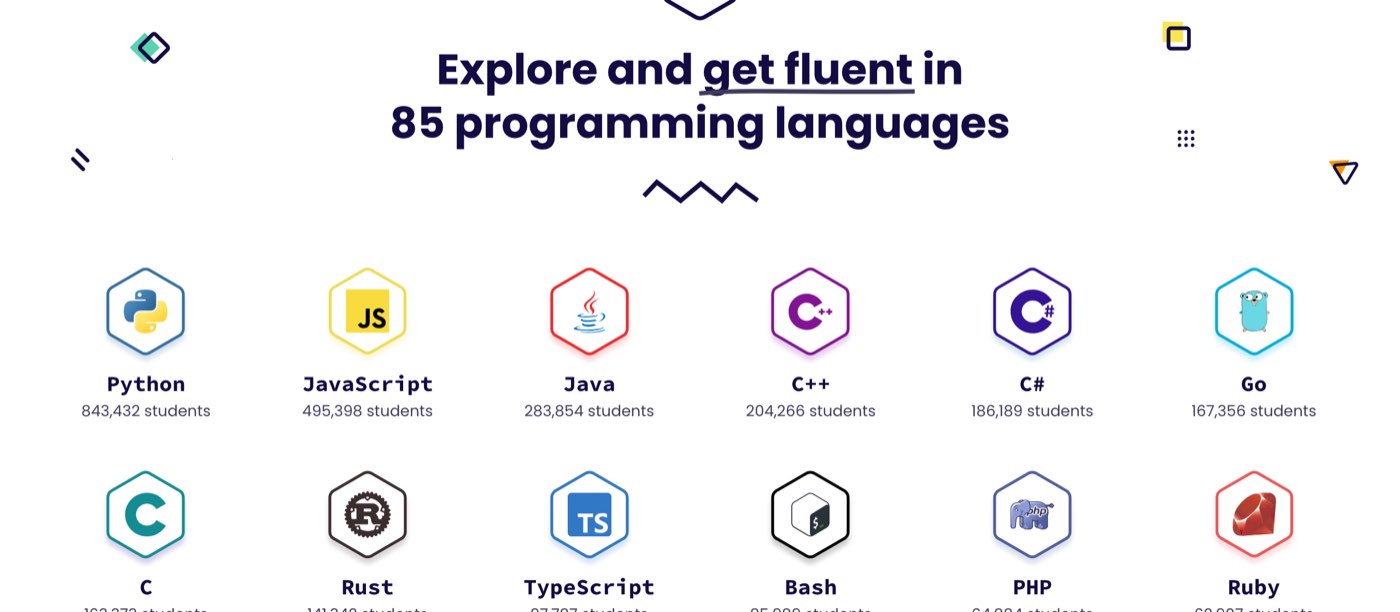
exercism.org on 31 October 2026 from Delhi: 85 language tracks, with the student count under each.
The student counts under each track give a sense of scale: Python 843,432 students, JavaScript 495,398, Java 283,854, C++ 204,266, C# 186,189, Go 167,356, C 163,373, Rust 141,342. Wikipedia records 1.9 million users as of May 2024 and 19,603 mentors as of February 2024. Katrina Owen started it in 2013 as a tool for her own students; Jeremy Walker is the co-founder and CEO.
Exercism exercises are katas in the test-driven sense. Its FAQ says each one gives you "a stub solution that you need to complete, and you will have a complete test suite that represents the requirements your solution must satisfy. This development methodology is a form of Test-Driven Development." The site is "primarily built as a CLI-first tool": you download an exercise with exercism download --exercise=<slug> --track=<track>, solve it in your own editor and submit from the terminal, or use the in-browser editor.
What you can do on Exercism without an account
You can read every exercise. We opened Leap on the Python track: the instructions, the Dig Deeper tab and the community solutions were all there, and the side panel offered "17 concepts, 146 exercises, and real human mentoring, all for free" behind a sign-up button. Solving needs the free account.
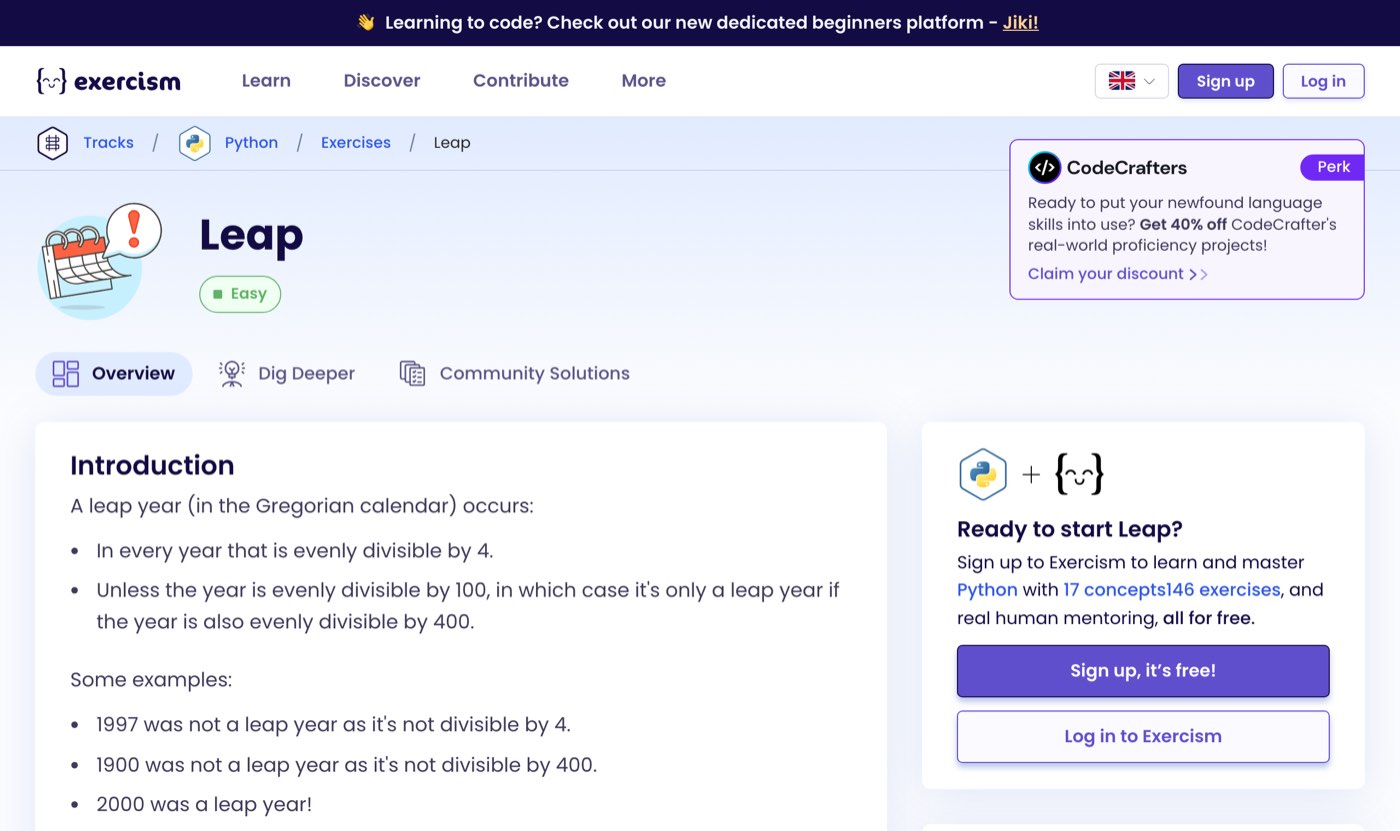
Exercism's Leap exercise on 31 October 2026, signed out: you can read every exercise, but solving one needs a free account.
Is Exercism really free?
Yes, and there is no plan to buy. The Insiders page says "Insiders isn't a product that you can buy - it's our way of saying thank you for those who contribute, mentor or donate. The easiest way to get Insiders access is by setting up a regular monthly donation of $10 or more." Insiders turns off adverts, adds a dark mode, badges and extra mentoring slots. The same page notes that "Exercism Premium was discontinued in August 2023".
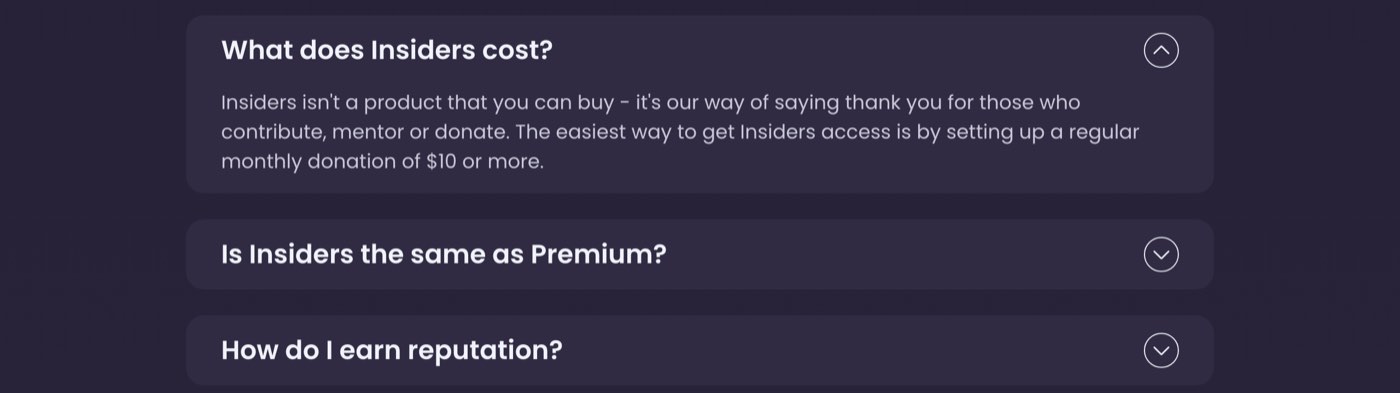
Exercism's Insiders page on 31 October 2026: there is no paid plan, only a thank-you tier for donors and contributors.
Pick Exercism when the goal is a new language rather than puzzle speed. The learning tracks unlock exercises in order, and a mentor will review your solution for idiom, which no automated test does. In October 2026 the site also pointed beginners to Jiki, its new learn-to-code platform, in a banner on every page.
3. cyber-dojo: best for TDD katas with no account
cyber-dojo is the only site here where we completed a full red-then-green test cycle without any login. It is built for deliberate practice of test-driven development, solo or as a group, by Jon Jagger, and it is run by the cyber-dojo Foundation, a Scottish charity (SC045890, incorporated 7 August 2015).
The setup page asks three questions: language, test framework, exercise. We chose Python, pytest and Fizz Buzz. The language list had 42 entries, from Ada and assembly to Zig, and the exercise list 61, from 100 Doors to Zeckendorf Number, with Bowling Game, Game of Life, Mars Rover, Roman Numerals, Tennis and Yatzy among them. There is also a "custom exercises" switch.
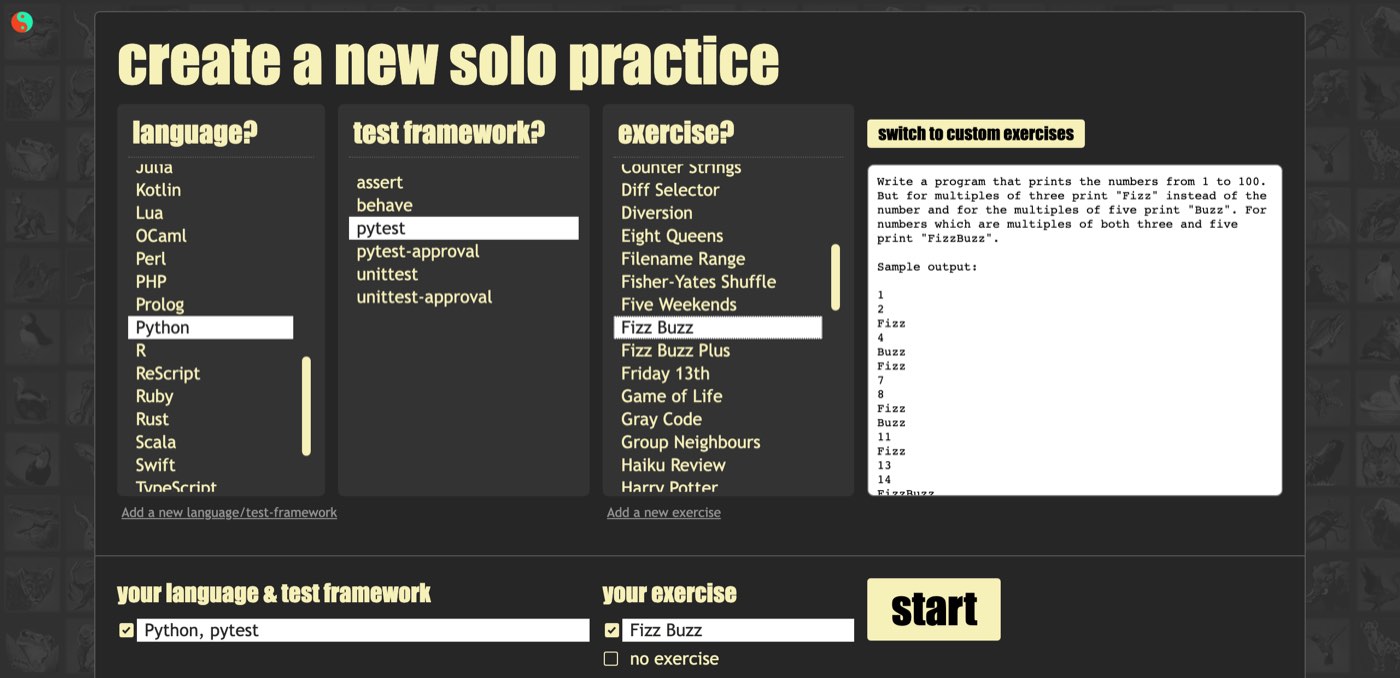
Setting up a solo practice on cyber-dojo.org on 31 October 2026: language, test framework, exercise, start. No account.
Our test run on cyber-dojo
Pressing start opened a session with four files: readme.txt (the exercise), hiker.py, test_hiker.py and cyber-dojo.sh. The starter code is deliberately wrong: global_answer() returns 6 * 9 and the test asserts 42. We pressed test. The output tab showed pytest 9.1.1 on Python 3.15.1, both tests FAILED with assert 54 == 42, and the traffic-light counter went red.
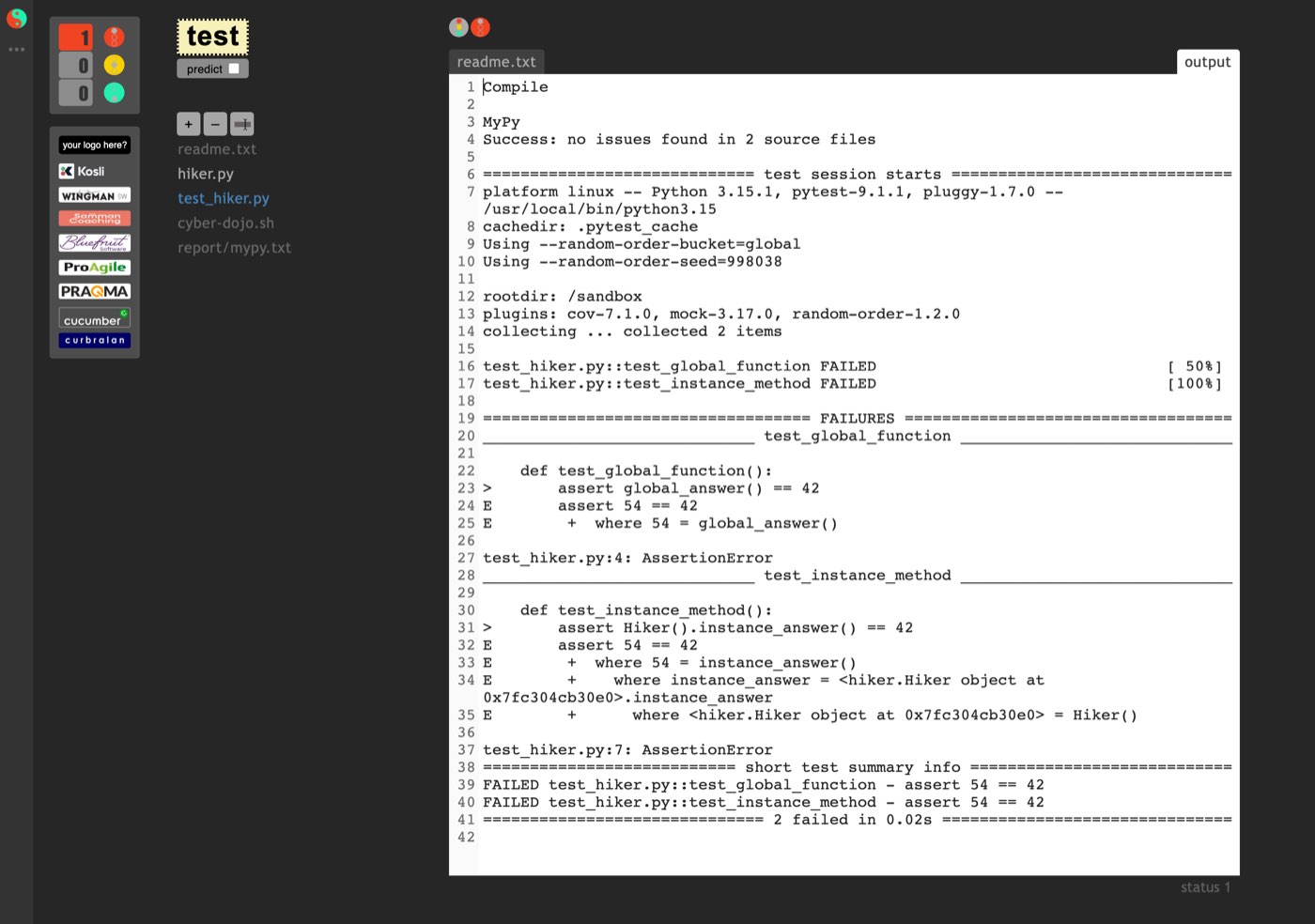
The first test run in our cyber-dojo session, 31 October 2026: the starter code returns 6 * 9, both tests fail with assert 54 == 42, and the first traffic light is red.
We changed 6 * 9 to 6 * 7 and pressed test again. The second run showed "2 passed in 0.01s" and a coverage table at 100%, and a green light appeared next to the red one. Each run is kept as a traffic light you can click to review or revert to. That history is the teaching tool: a coach can see whether you took small steps or one big leap.
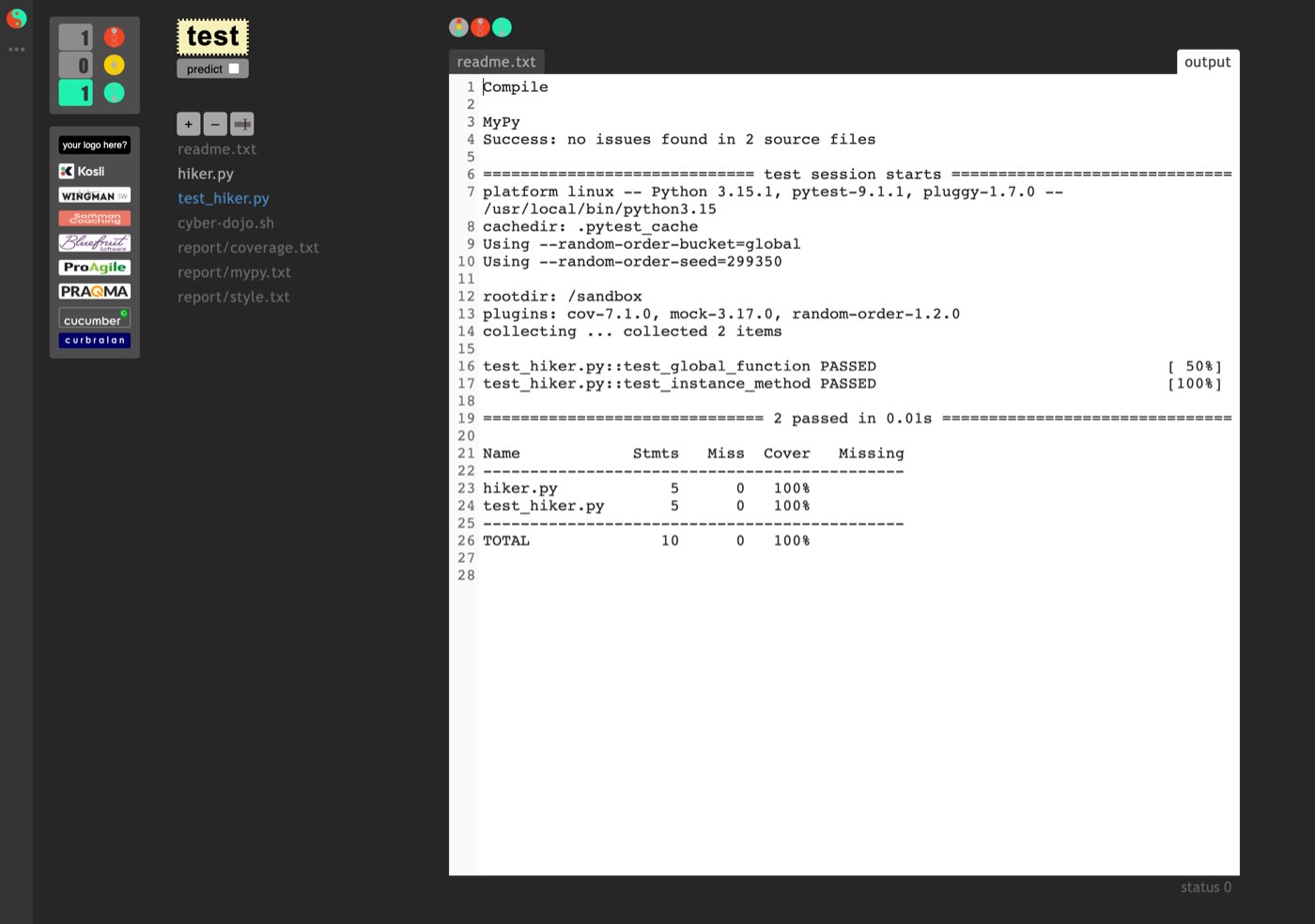
The second run after the one-character fix: 2 passed, 100% coverage, and a green light next to the red one.
Both runs took about two seconds. The starter files are "unrelated to the exercise", as their docstring says; they show the testing style, and you replace them with your Fizz Buzz code and tests.
Is cyber-dojo free?
For individuals and non-commercial use, yes. The homepage says that "Using https://cyber-dojo.org in a commercial organization requires a licence", that "Large companies/organizations typically pay ~ £1000" and smaller teams less, with the amount and the term up to the buyer. All fees and donations go to the charity, and hosting is paid by its sponsors, Kosli and CodeEntropy. The server is open source on GitHub, so a company can also run its own.
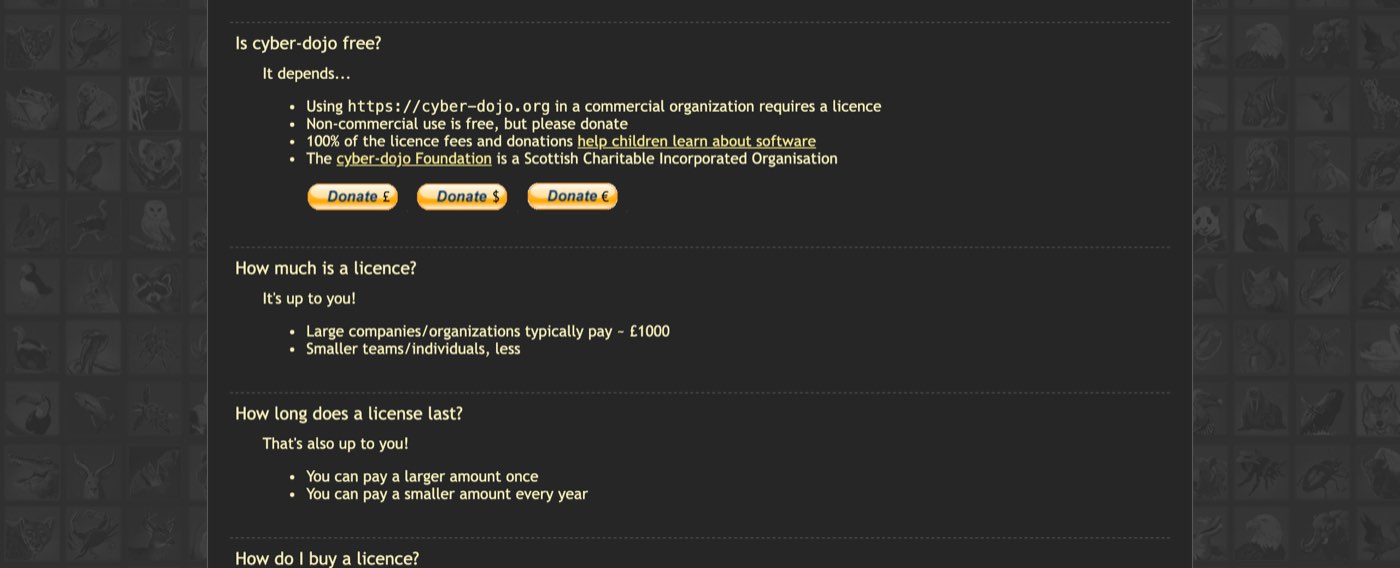
cyber-dojo's own answer on cost, 31 October 2026: free for non-commercial use, a pay-what-you-decide licence for companies.
Pick cyber-dojo for a coding dojo at work or a class, or for practising TDD on your own with the classic katas. Its editor is plain, there are no ranks or badges, and that is the point.
4. Edabit: best for tiny beginner drills
Edabit is the gentlest site on the list. Its homepage on 31 October 2026 promised "10,000+ tiny programming problems" (the challenges page title says 17,000+), in eight languages: C#, C++, Java, JavaScript, PHP, Python, Ruby and Swift. Challenges run from Very Easy up, and each has Resources and Solutions tabs for when you are stuck.
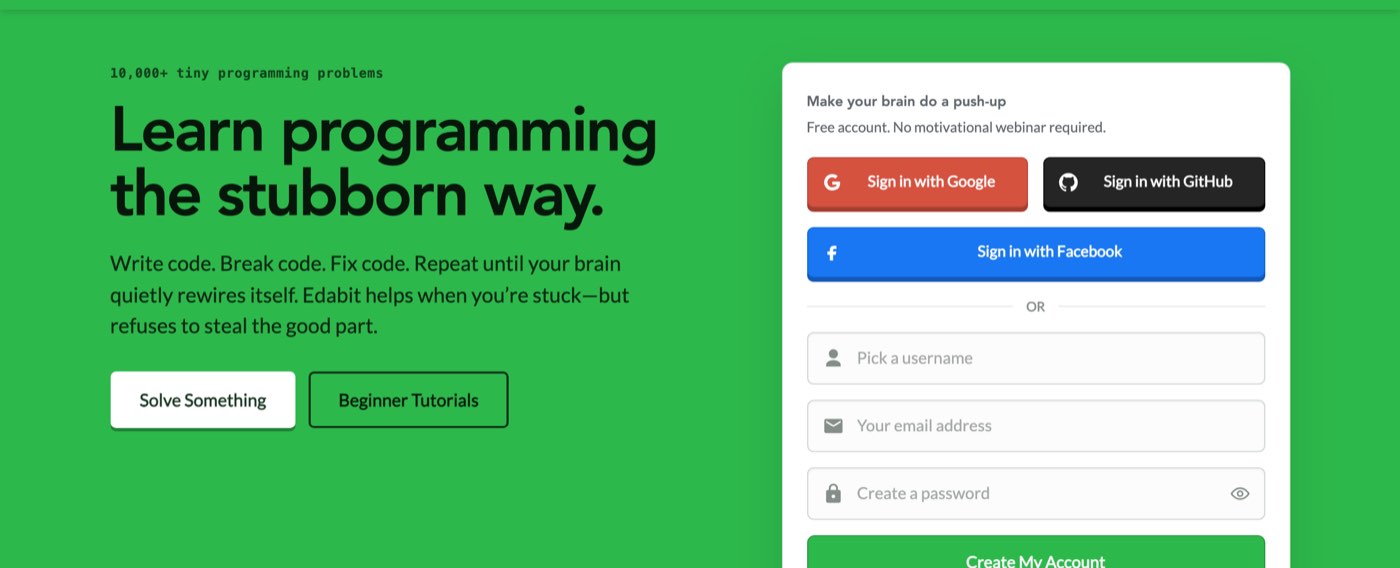
edabit.com on 31 October 2026 from Delhi.
Our test run on Edabit
We opened the first Python challenge, How Edabit Works, signed out. The task is to make hello() return "hello edabit.com". Pressing Check with the empty function first produced a readable failure from its "Coach" panel: "Expected an indented block after function definition", with a What's Wrong, Why It Fails and Try Next explanation. With the one-line answer in place, Check passed and a "CHALLENGE COMPLETE" window popped up. No account was asked for at any step, though votes and progress need one.
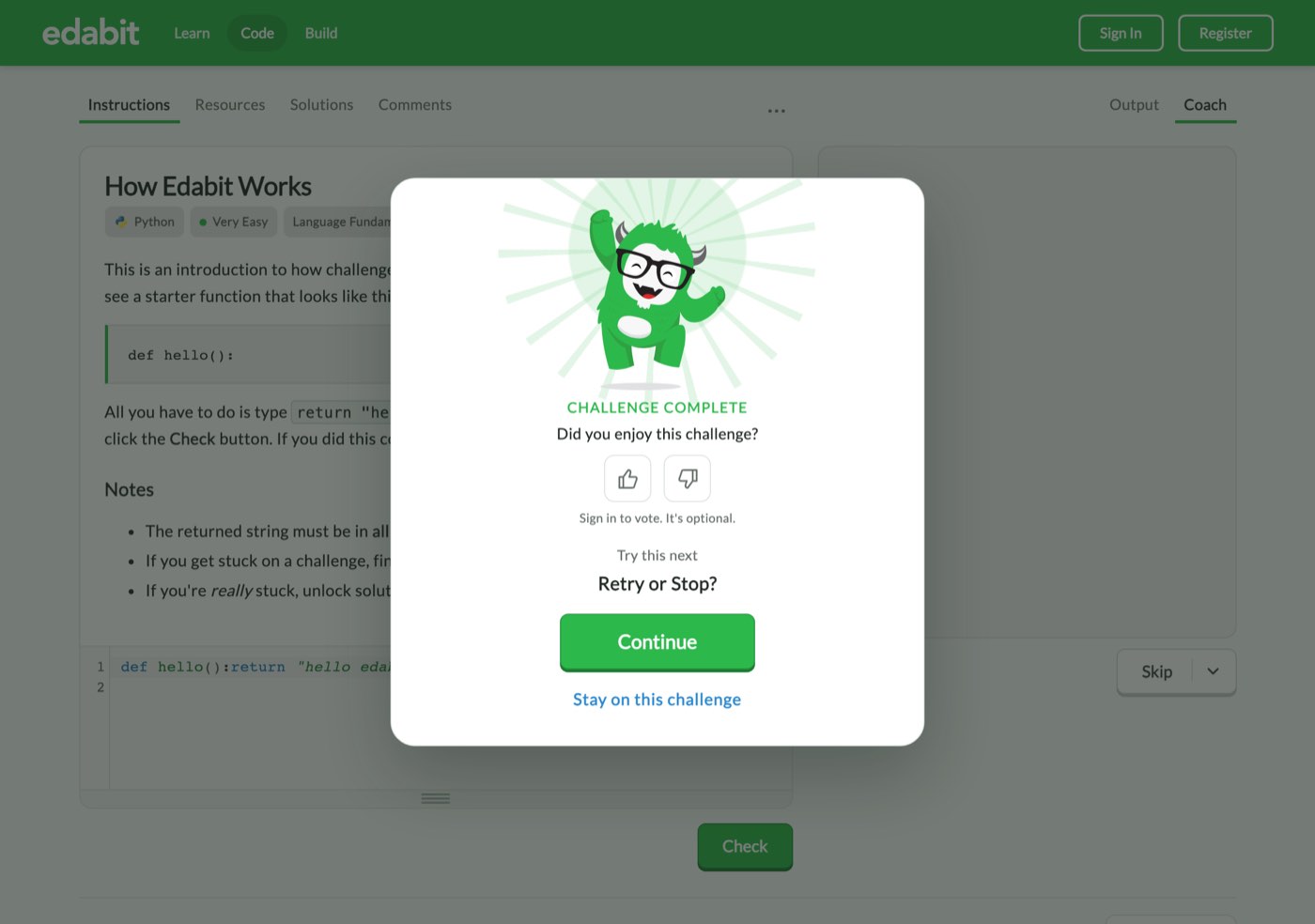
Edabit ran our one-line Python answer and showed CHALLENGE COMPLETE without an account, 31 October 2026.
Pick Edabit for the first month of a language, or for a five-minute warm-up. The problems are too small to teach design, which is where Codewars' higher kyu and cyber-dojo's katas take over.
5. CodinGame: best for puzzles with a game on screen
CodinGame wraps each puzzle in a game. Your program reads the game state from standard input and prints an action, and a viewer replays what happened. The easy training list is organised by the concept each puzzle teaches: Onboarding (Conditions), The Descent (Loops), Power of Thor, Temperatures, Mars Lander. Onboarding alone had been "Completed by 2,922,618 CodinGamers".

CodinGame's easy puzzle list on 31 October 2026. Each tile names the concept it drills.
Our test run on CodinGame
The IDE for Onboarding loaded signed out, with a "CONTINUE WITHOUT AN ACCOUNT" option and Python 3 selected. We pressed Play All Testcases with the untouched starter code, which prints "name of the enemy" every turn. The game viewer showed "YOU LOSE!", the console explained that the output "is not one of the remaining ship names", and test case 01 failed with "Failure: You were destroyed". So the runner works as a visitor; saving progress, levels and leaderboards need the free account.
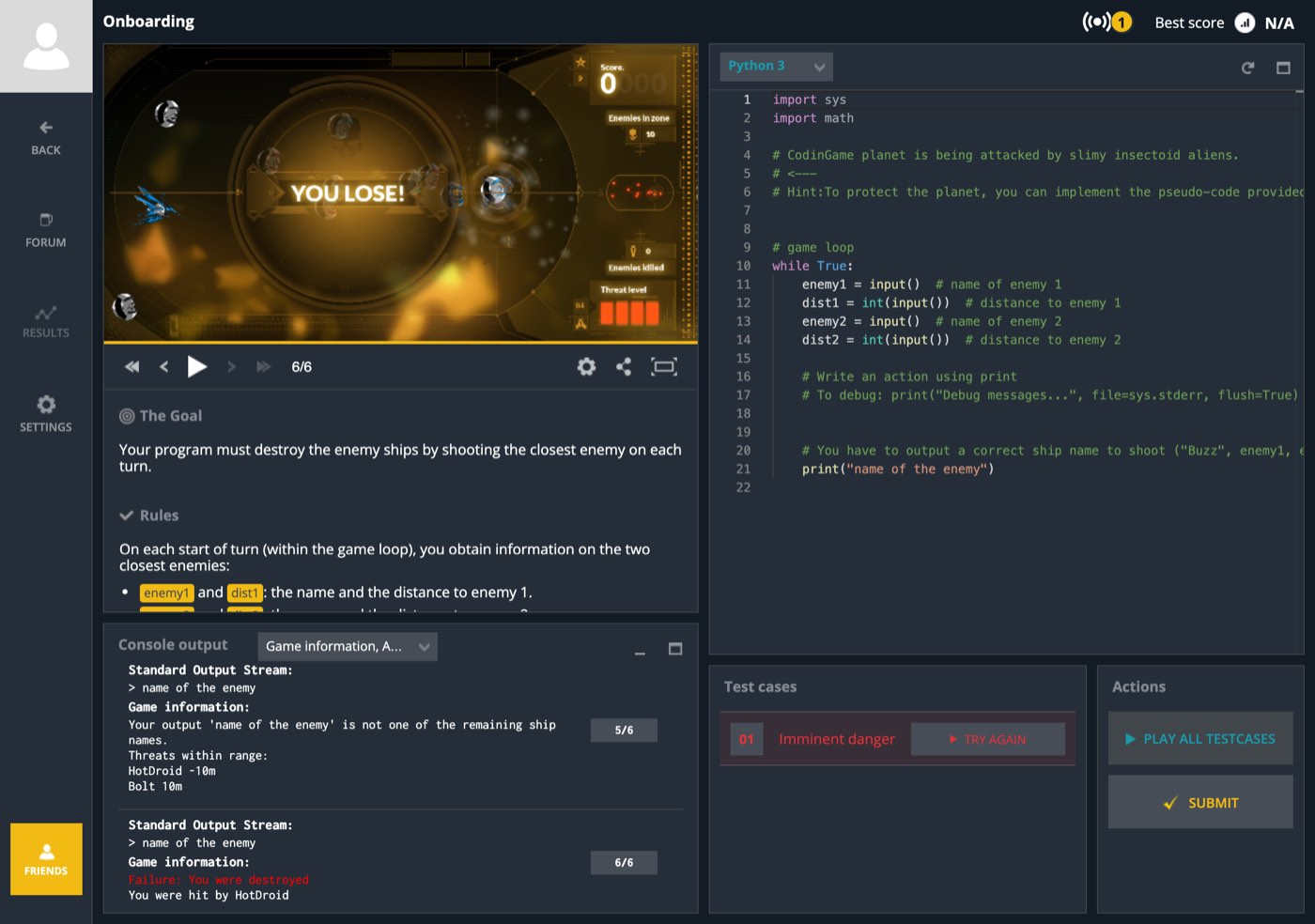
CodinGame's Onboarding puzzle run signed out on 31 October 2026 with the untouched Python 3 starter code: the test case fails and the game viewer shows why.
One caution: the homepage no longer talks about puzzles. On 31 October 2026 it was headed "The arena for engineering agents" and invited you to "Connect Codex, Claude Code, or your own harness" to play its bot games through an API. The site is "CodinGame by CoderPad", the interview-tool company. The human practice section still works at /training, which is the link to bookmark.

codingame.com on 31 October 2026: the homepage now sells an arena for coding agents, while the puzzle practice lives on under /training.
6. LeetCode: best for interview problems, not katas
LeetCode is where interview preparation happens, and it is on every "kata sites" list for that reason. Wikipedia describes it as "an online platform for software coding interview preparation", founded in 2015 by Winston Tang in Palo Alto, with 26.3 million monthly visitors as of 2025. Its problems have hidden tests, time limits and company tags, and the discussion threads are about Big-O rather than readability.
We could not test it hands-on. leetcode.com answered our headless browser with a Cloudflare "Performing security verification" page, and we did not try to get around it. Read through a text proxy, the Premium page listed $39 a month billed monthly or $299 billed annually, in US dollars, and said Premium adds company-specific questions, solution analysis and extra credits for its "Ask Leet" coding agent. The free tier still has most problems and the daily challenge.
Pick LeetCode if an interview is coming. For technique practice it is the wrong tool: the problems reward a known algorithm, not the small, repeated improvements a kata is for. If you are new to data structures, our explainer on what a data structure is covers the ground LeetCode assumes.
7. HackerRank: topic tracks that still exist behind a hiring site
HackerRank's practice section, under "Prepare", still has its domains: the Algorithms track opens with Solve Me First (success rate 97.56%), Simple Array Sum and Compare the Triplets, each with a max score and a difficulty label. There are also skill certificates. All of it is free for the person practising; HackerRank's customers are employers.
The homepage makes that plain. On 31 October 2026 its top banner read "Sorry, we made you grind l**tcode. We've changed", above products called Chakra ("Agentic interviewer"), Screen and Interview. The company is distancing itself from grind-style practice, which is a strange position for a site on this list, but the tracks remain.
We could not run anything: www.hackerrank.com returned an Akamai "Access Denied" page to our headless browser, and the problem pages did the same. The text above comes from a plain fetch of the page source and a text proxy, which the site did allow.
8. Project Euler: maths problems in any language
Project Euler is a series of mathematical programming problems started on 5 October 2001 by Colin Hughes. Its archive showed problems 1 to 1006 on 31 October 2026, with a new one most weeks. Problem 1, "Multiples of 3 or 5", had been solved by 849,046 people; problem 2 by 679,283. The about page counted 151,234 members who have solved at least 25 problems, in 220 locations, using 114 languages.
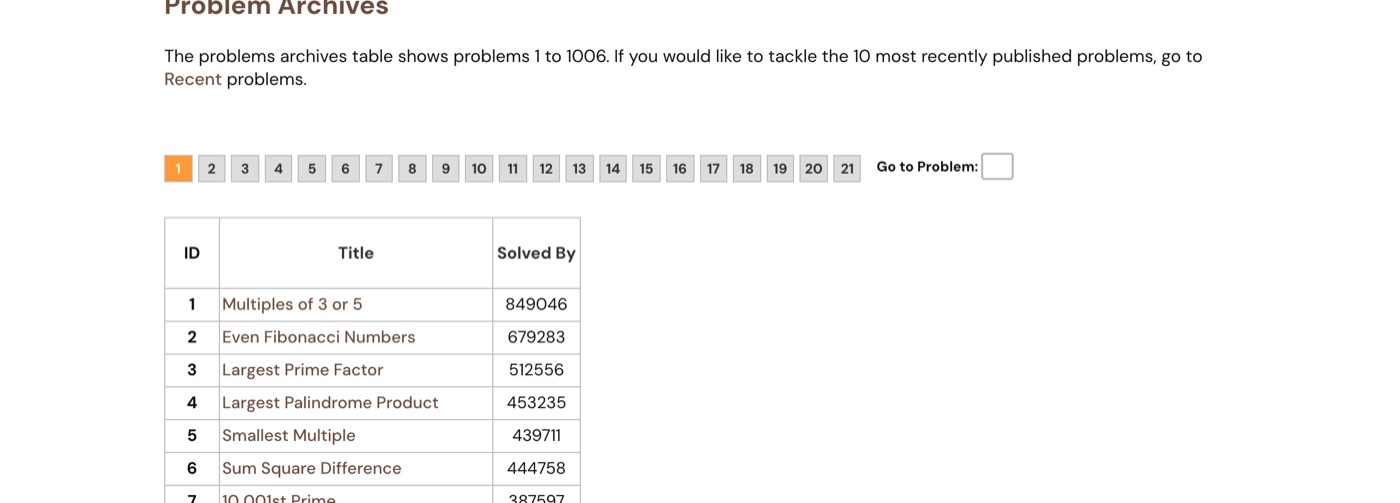
Project Euler's archive on 31 October 2026: 1,006 problems, and the solved-by count beside each.
Nothing runs on the site. You solve the problem on your own machine and submit a number, so any language works, and the about page says it is "completely free" to register and that the problems are aimed at students, professionals and "the inquiring mind". It is a kata site only in the sense that the early problems are small and worth redoing in a new language; past problem 100 they are serious mathematics.
9. Advent of Code: a puzzle a day in December
Advent of Code is Eric Wastl's yearly set of Christmas-themed puzzles, running since 2015. On 31 October 2026 the homepage said "The first puzzles will unlock on December 1st at midnight EST (UTC-5)", with the 2015 to 2025 events open to replay. Like Project Euler, you submit answers, not code, so any language goes. Wikipedia notes that from 2025 the event ends on 12 December instead of 25, and only private leaderboards remain.
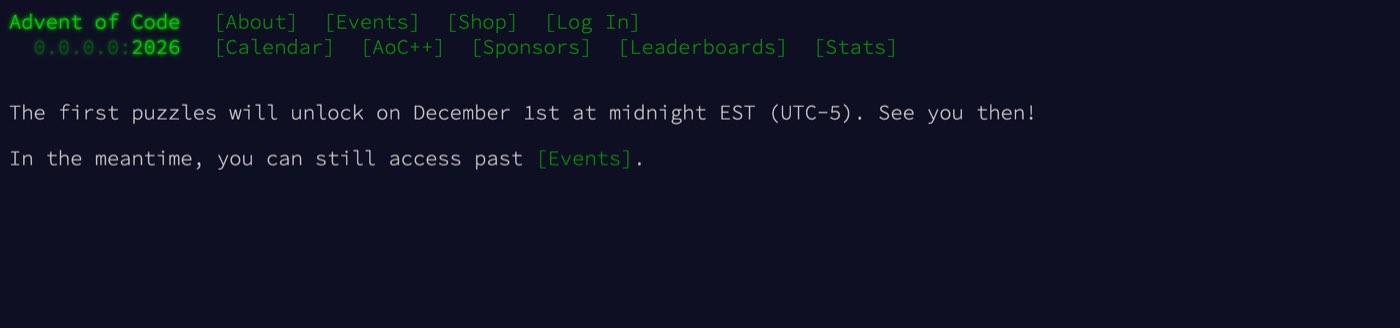
adventofcode.com on 31 October 2026, waiting for 1 December.
It is free; the AoC++ page says "Advent of Code is free to use" and asks for a contribution if you can. Its about page lists the ways people use it: "interview prep, company training, university coursework, practice problems, a speed contest". The past years are the useful part for kata practice: 250-plus two-part puzzles with examples in the text, each fine for a 30-minute timebox.
10. Kata catalogues: the exercises without a platform
The classic katas live in catalogues, not apps. They give you a problem statement and leave the editor, language and tests to you, which is how Dave Thomas intended them.
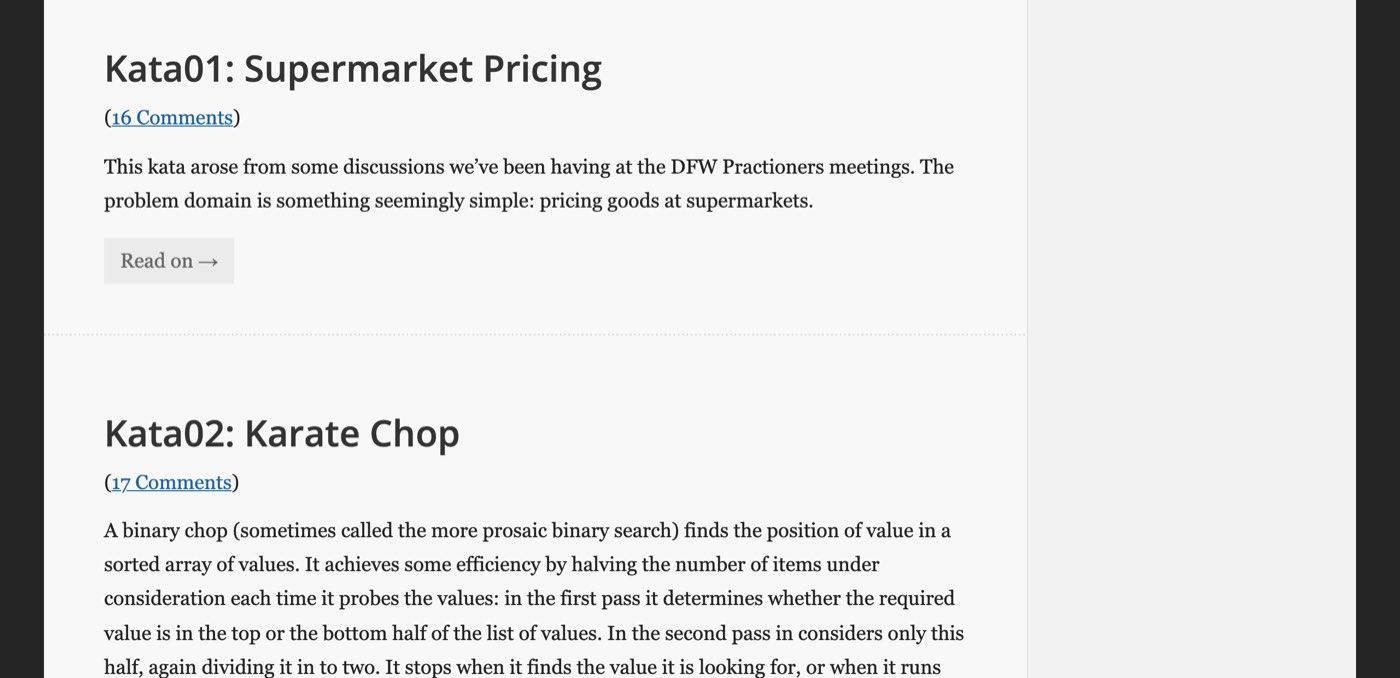
codekata.com on 31 October 2026: the original 21 katas, each a page of prose with no code runner.
CodeKata: Dave Thomas's original 21, numbered Kata01 to Kata21, each a page of prose with a comment thread. Karate Chop (binary search five ways) and Data Munging are the famous ones.
Kata-Log: 31 katas, each tagged by level (Starter or Experienced), topic (TDD, Refactoring, SOLID, Mocks, Outside-In, Golden Master) and a constraint to practise under, such as Baby Steps, No Primitives, Mute Ping Pong or The 70s Compiler. It includes Bowling Game, Gilded Rose, Mars Rover, Roman Numerals, Tennis and Yatzy.
Samman Coaching kata descriptions: Emily Bache's collection, 38 katas under CC BY-SA 4.0, with the advice to "give yourself a timebox to work on it, perhaps 30-60 minutes. Use Test-Driven Development." Her refactoring katas (Gilded Rose, Tennis, Theatrical Players, Supermarket Receipt) come with starter code on GitHub.
Coding Dojo KataCatalogue: the community list from the original dojo movement, grouped as Algorithmic, Game Modeling, String manipulation and Refactoring legacy code: BankOCR, Potter, Bowling, Minesweeper, Poker Hands.
awesome-katas on GitHub: a curated index of the above and more.
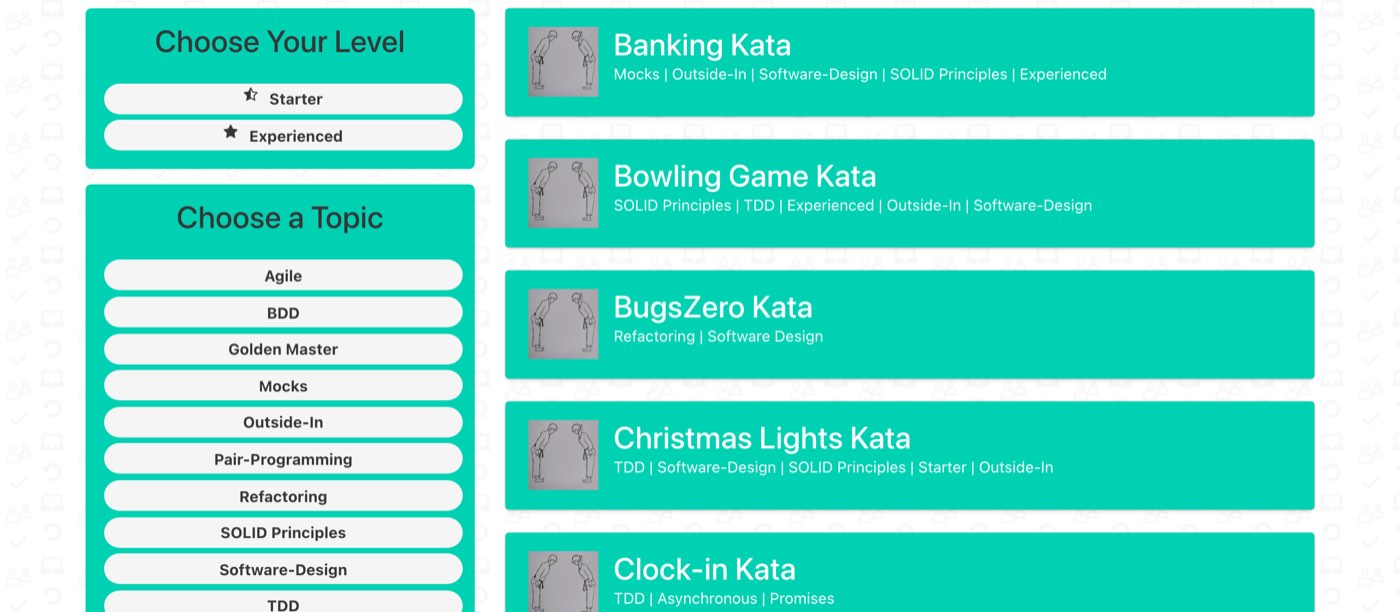
kata-log.rocks on 31 October 2026: each kata is tagged by level, topic and the constraint you can practise it under.
Catalogue katas pair well with cyber-dojo, which has most of them as named exercises, or with your own repository and test runner. If your katas live in a terminal, a readable font helps; our best coding fonts guide compares 16 of them from their font files.
Which coding kata sites work without an account?
Three of the ten ran our code signed out: cyber-dojo, Edabit and CodinGame. Two more let you read everything but not run it: Codewars shows the kata, starter code and sample tests, and Exercism shows the instructions and community solutions. Project Euler and Advent of Code show the problems and need an account only to check answers. LeetCode and HackerRank blocked the browser we used before any page loaded, so we cannot say.
Site | Signed out, 31 October 2026 |
|---|---|
cyber-dojo | Full session: tests ran red, then green, no login |
Edabit | Check ran and the challenge completed |
CodinGame | IDE ran all test cases after "Continue without an account" |
Codewars | Kata, code and sample tests visible; Test and Attempt hidden |
Exercism | Exercise and solutions visible; solving needs a free account |
Project Euler, Advent of Code | Problems visible; answers checked only for accounts |
LeetCode, HackerRank | Bot checks stopped the browser; not tested |
How to choose a coding kata site
Choose by the skill you want to build, not by the longest feature list. Most roundups of coding websites mix learn-to-code courses with practice sites; the list above is practice only, so the choice comes down to four goals.
Daily fluency in a language you know: Codewars. Ranks give you a reason to come back, and the solutions page teaches idioms.
A new language, properly: Exercism. Ordered exercises, a mentor, and the CLI so you work in your own editor.
Test-driven development and design skills: cyber-dojo with the classic katas, or a catalogue kata in your own repository. These are the only ones where the tests are the exercise.
An interview in the next month: LeetCode, with HackerRank's tracks for topic gaps. Different skills, different sites.
Two practical checks before you commit: whether the site runs your language (Codewars' 58 against Edabit's 8), and whether you can try it without an account, which the table in the previous section answers.
Which coding kata site is best for beginners?
Edabit for the first weeks, then Codewars at 8 kyu and 7 kyu. Edabit's problems are one function long and its Coach explains a failure in plain words, which is what a beginner needs at the start. Codewars' lowest ranks are the same size but you see other people's solutions after each one, which is how you learn the idioms. If you are learning a specific language, Exercism's track for it is the better path, because the exercises are ordered by concept and a mentor reads your code.
Avoid LeetCode until the basics are automatic. Its easy problems assume you already know arrays, hash maps and recursion, and its scoring rewards speed.
Codewars vs LeetCode: which should you use?
Codewars for technique, LeetCode for interviews. Codewars katas are community-written, ranked from 8 kyu to 1 kyu, solvable in 58 languages, and followed by a page of other solutions to compare with yours; the paid tier is $5 a month and changes nothing about the katas. LeetCode problems are interview questions with hidden tests, company tags and a $39-a-month Premium that unlocks the company-specific sets. Many developers use both: a kata a day on Codewars all year, LeetCode for the month before interviews.
How to practise a coding kata
Timebox it. Samman Coaching suggests 30 to 60 minutes. Stop when the time is up, even if it is not finished.
Write the test first. On cyber-dojo and Exercism the tests are the exercise. On Codewars, read the sample tests before the description.
Repeat the same kata. "The next time you work on that kata, start over from scratch," says the Samman page. The second and third attempts are where the technique improves.
Add a constraint. Kata-Log's list: Baby Steps (revert if a step takes more than two minutes), No Primitives, Tell Don't Ask, a new language.
Compare solutions. On Codewars, read the top-voted solutions after yours passes. On Exercism, read the community solutions and ask for mentoring.
Keep a log. cyber-dojo's traffic lights do this for you; elsewhere, a commit per step in a katas repository works.
A kata is not a tutorial, so pair it with one when a concept is new. Our regex cheat sheet, for example, is the reference to keep open during the string katas.
How this was checked, and how the sites were compared
The sites were compared on the same five points for each: what it is best for, whether it is free and what the paid tier costs, whether code runs signed out, how many languages it supports, and what we could do in a fresh browser.
Everything above was read or run on 31 October 2026, in the first hours of the day in Delhi (the evening of 30 October in UTC), from a home broadband connection, in Playwright's headless Chromium with a fresh profile, no cookies and no account on any site. We did not change the browser's identity, and when a site's bot check stopped the browser (LeetCode's Cloudflare page, HackerRank's Akamai page) we stopped too and read those pages through a plain fetch or a text proxy instead. Each screenshot is a crop of the live page at the time, with the date in its caption.
The hands-on runs were: a cyber-dojo solo session (Python, pytest, Fizz Buzz) with two test runs, first failing on assert 54 == 42 and then passing after one edit; Edabit's How Edabit Works challenge, checked once empty and once with the one-line answer; CodinGame's Onboarding puzzle, run with the untouched Python 3 starter code; and the Codewars Multiply kata, opened signed out to see which controls appear.
Prices come from each site's own pricing or subscription page as loaded from Delhi, in the currency shown, and the counts (languages, exercises, problems, completions) are the numbers those pages displayed that day. Founding dates and ownership come from the sites' own pages and from Wikipedia where noted.
What we did not do: sign in anywhere, so ranks, mentoring, streaks and leaderboards were not tested; run LeetCode or HackerRank problems; or test the mobile apps. The capture scripts and the saved page sources are kept with the draft, and the article will be rechecked when any site changes its prices or its free tier.
Frequently asked questions
What is a coding kata?
A coding kata is a short programming exercise you repeat to sharpen technique, named by Dave Thomas after the karate forms practised many times. Sites such as Codewars use "kata" for every challenge; catalogues such as CodeKata and Kata-Log describe classic ones to do in your own editor.
Which is the best coding kata site for beginners?
Edabit, then Codewars at 8 kyu. Edabit's challenges are one function long and run without an account, with a hint panel that explains failures. Codewars adds ranks and lets you compare your solution with others once it passes.
Is Codewars free?
Yes. All katas, ranks and 58 languages are free with an account. Codewars Red, the optional tier, cost $5 a month, $24 every six months or $40 a year on 31 October 2026, and adds statistics, an ad-free view and a badge.
Can I practise coding katas without creating an account?
Yes, on cyber-dojo, Edabit and CodinGame, which all ran our code signed out on 31 October 2026. Codewars and Exercism let you read exercises but need a free account to run or submit a solution.
Is Codewars better than LeetCode?
For practice, yes; for interviews, no. Codewars is built around small ranked katas and shared solutions in many languages, while LeetCode is interview preparation with hidden tests and a $39-a-month Premium for company-specific questions.
How many languages does Codewars support?
Codewars advertises 55+ languages. Its docs listed 58 on 31 October 2026, 29 stable (including Python, JavaScript, Java, C#, C++, Go, Rust, Kotlin, Swift, TypeScript and SQL) and 29 in beta.
Is Exercism really free?
Yes. Exercism says it is "100% free, forever": 85 language tracks, 8,763 exercises and human mentoring at no cost. Insiders is a thank-you tier for people who donate $10 or more a month or contribute, not a paywall.
How often should I do coding katas?
Little and often beats long sessions. A 30-to-60-minute timebox a few times a week, repeating the same kata until it is easy and then changing the language or adding a constraint, is the routine the kata catalogues recommend.
Do coding kata sites help with job interviews?
Indirectly. Katas build fluency and test-first habits, which show in any live coding round. For the algorithm questions interviews actually ask, LeetCode and HackerRank's tracks are closer to the real thing, so use them in the weeks before an interview.
Student at Netaji Subhas University of Technology (NSUT) writing about AI, automation and new digital tools, with a year of hands-on experiments behind the articles.
See everything by @ashutosh-sharmaEdited by Rajat Chauhan. How articles here are written and edited.
0 comments
Sign in to join the discussion.
Loading comments…