What is DBMS? A DBMS (Database Management System) is software that stores data, lets programs find and change it with a query language such as SQL, and enforces rules so the data stays correct despite many users and crashes. MySQL, PostgreSQL, Oracle, SQLite and MongoDB are DBMSs. Below, SQLite is put through each job, with one million rows.
What is the full form of DBMS?
DBMS stands for Database Management System. The database is the data itself, organised in tables or documents. The management system is the program that sits between that data and everyone who uses it: it decides how the data is laid out on disk, answers queries, checks every change against the rules, and keeps a record so that a crash does not leave the data half-written. RDBMS, which you will also see, stands for Relational Database Management System, the most common kind.
What is DBMS used for that a file cannot do?
You can keep data in a spreadsheet or a CSV file, and many small projects do. The difference shows up when the data grows, when two people write at once, or when the power goes. To make it concrete, we put the same one million user records, each with an id, an email, a city and an age, into a CSV file and into a SQLite table, and asked each to find 200 users by email. The script and its output are described at the end.
Where the data lives | 200 lookups by email | Per lookup |
|---|---|---|
CSV file, read from the top each time | 30.6 seconds | 153 ms |
DBMS table, no index | 7.3 seconds | 36 ms |
DBMS table, with an index on email | 1.2 ms | 0.006 ms |
The table without an index is four times faster than the file only because the DBMS stores rows compactly; it still reads all million of them. Adding one index, which took 0.38 seconds to build, made the same 200 lookups about 6,000 times faster than the unindexed table and 26,000 times faster than the file. An index is a B-tree, the sorted tree structure our data structures guide times against a plain list; the DBMS builds it, keeps it up to date on every insert, and chooses to use it on its own.
You can see that choice. SQLite's EXPLAIN QUERY PLAN command, which its documentation describes as "a high-level description of the strategy or plan that SQLite uses", printed SCAN users before the index existed and SEARCH users USING INDEX users_email (email=?) after. Nothing in the query changed. That separation, where you say what you want and the DBMS decides how to get it, is the main reason databases exist.
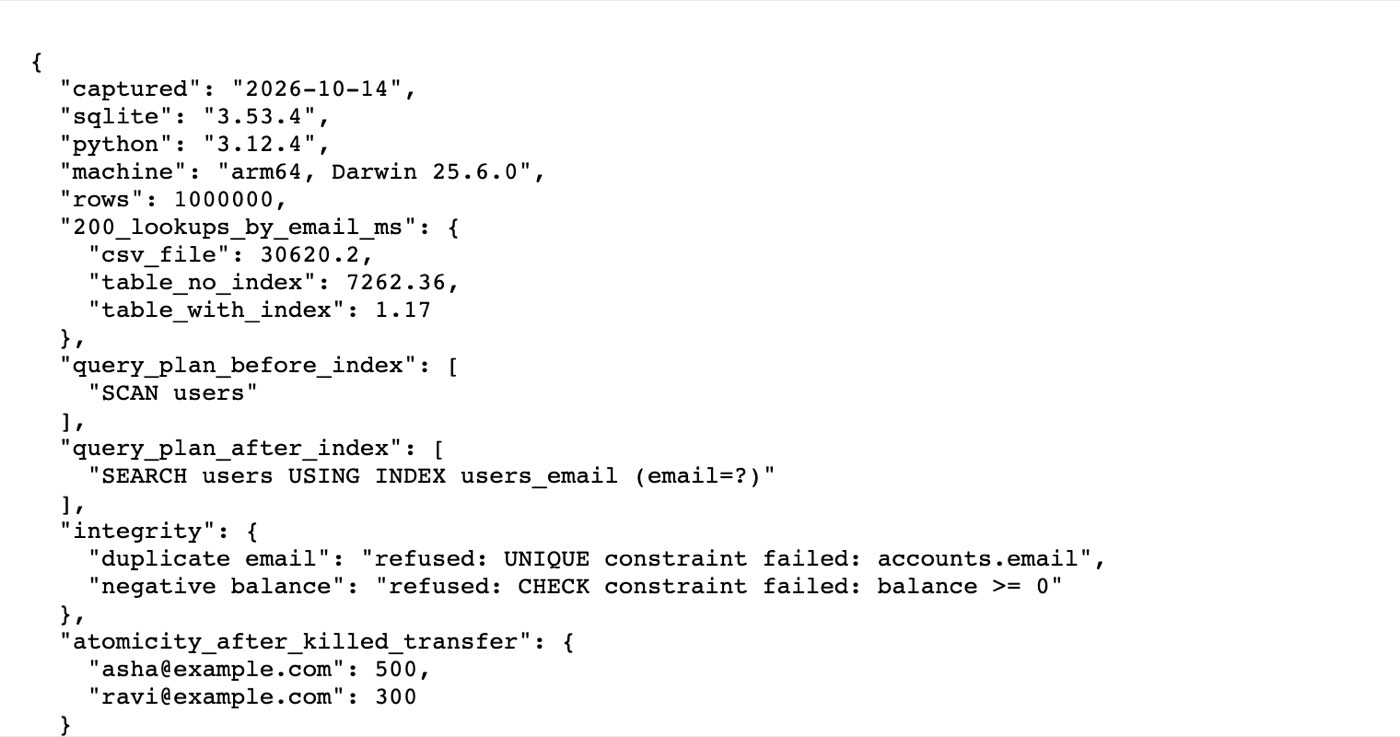
The test's own output file, summary.json, written on October 14, 2026 with SQLite 3.53.4. Every figure in this article is in it.
What are the 5 main functions of a DBMS?
Textbooks list them in slightly different words, but they come down to five, and the test above exercised four of them.
Storing and retrieving data efficiently. The DBMS decides the file layout, builds indexes and plans each query. That is the 30.6 seconds against 1.2 milliseconds above.
Defining and changing the data. A data definition language (
CREATE TABLE,ALTER TABLE) describes the structure, and a data manipulation language (SELECT,INSERT,UPDATE,DELETE) works on the rows. In relational systems both are SQL.Enforcing integrity. Rules declared once are checked on every write, by every program. In our test, inserting a second account with an existing email failed with
UNIQUE constraint failed: accounts.email, and setting a balance below zero failed withCHECK constraint failed: balance >= 0. A CSV file accepts both without a murmur. Our article on why only the database knows if a value is taken explains why checking in application code is not enough.Transactions and concurrency. A group of changes either happens completely or not at all, and many users can work at once without seeing each other's half-finished changes. The crash test below shows the first part.
Security, backup and recovery. User accounts and permissions decide who can read or change which tables, and logs and backups let the data be restored after a failure. Server databases such as PostgreSQL handle permissions per user; SQLite, which runs inside one program, leaves access to the file system.
What is ACID, and does it really hold?
ACID names the four guarantees of a transaction: Atomicity (all or nothing), Consistency (every rule holds before and after), Isolation (concurrent transactions do not see each other's partial work) and Durability (once committed, it survives a crash). SQLite's documentation makes the claim plainly: its transactions are ACID "even if the transaction is interrupted by a program crash, an operating system crash, or a power failure to the computer".
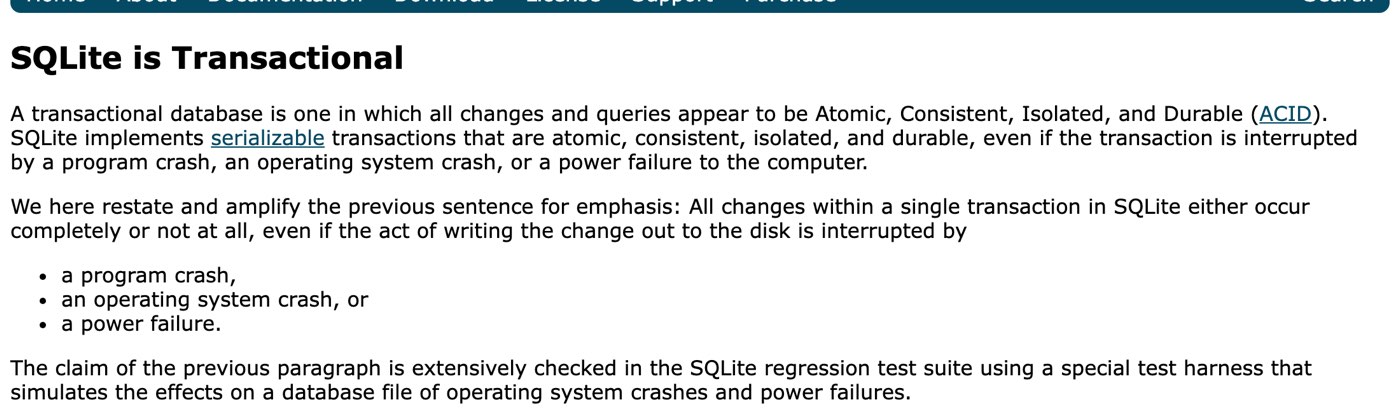
sqlite.org's "SQLite is Transactional" page on October 14, 2026: all changes in a transaction "either occur completely or not at all".
The test checked the atomicity half, and the result is in the output file above. Two accounts started with 500 and 300. A separate process began a transfer of 200, took it out of the first account, and was then killed before it could add it to the second, the software equivalent of the power going out between two lines of code. When the database was opened again, the balances were 500 and 300: the half-done debit had vanished, and the total was still 800. Without a transaction, the 200 would simply have disappeared.
BEGIN;
UPDATE accounts SET balance = balance - 200 WHERE id = 1;  -- done
-- process killed here: no COMMIT, no credit to account 2
UPDATE accounts SET balance = balance + 200 WHERE id = 2;  -- never runs
COMMIT;
What are the types of DBMS?
DBMSs are grouped by the shape they give data. The first two are mostly history; relational systems run most of the world's applications; NoSQL systems fill the cases relational ones handle badly.
Type | How data is shaped | Examples | Good at |
|---|---|---|---|
Hierarchical | A tree: each record has one parent | IBM IMS (1960s) | Fixed one-to-many data, such as an organisation chart |
Network | A graph of records with many-to-many links | IDMS, CODASYL systems | Complex links, before relational systems replaced it |
Relational (RDBMS) | Tables of rows and columns, linked by keys | MySQL, PostgreSQL, Oracle, SQL Server, SQLite | Almost everything: accounts, orders, bookings |
Object-oriented (OODBMS) | Objects as in a programming language | db4o, ObjectDB | Programs that store objects directly |
Document (NoSQL) | JSON-like documents | MongoDB, Couchbase | Records whose fields vary |
Key-value (NoSQL) | A key and a value, like a hash table | Redis, DynamoDB | Caches and sessions at high speed |
Column-family (NoSQL) | Rows grouped by column families | Cassandra, HBase | Huge write volumes spread over many servers |
Graph (NoSQL) | Nodes and relationships | Neo4j | Networks: friends, routes, fraud rings |
Cloud (DBaaS) | Any of the above, run by a provider | Amazon RDS, Google Cloud SQL, Azure SQL Database | Teams that want backups, scaling and monitoring handled for them |
The relational model comes from a single paper, Edgar F. Codd's "A Relational Model of Data for Large Shared Data Banks", published in 1970. Its idea was the one our test showed: users describe the data they want, and the system works out how to fetch it.
What are the components of a DBMS?
From the outside it is one program. Inside, the parts most courses list are:
Storage engine: lays out tables and indexes in files, in pages read from disk. It relies on the operating system's file system underneath.
Query processor: parses SQL, chooses a plan (the
SCANorSEARCHabove), and runs it.Transaction manager: keeps the log that makes the crash test come out right, and locks rows or pages so concurrent users do not clash.
Catalog (data dictionary): the database's description of itself: every table, column, type, index and constraint.
Access control: users, roles and permissions.
Some textbooks list the components differently, as hardware, software, data, procedures and users. Both lists are asked in exams; the one above is what you meet when you use a real system.
What are the 5 keys in DBMS?
A key is a column, or a set of columns, that identifies rows. Take a students table with roll number, email, Aadhaar number and name.
Super key: any set of columns that identifies a row uniquely, even with extra columns in it. (roll number, name) is a super key.
Candidate key: a super key with nothing extra; remove any column and it stops being unique. Roll number, email and Aadhaar number are each candidate keys.
Primary key: the candidate key chosen to identify rows. It cannot be empty or repeat. Usually roll number.
Alternate key: the candidate keys not chosen: here, email and Aadhaar number. They are usually declared
UNIQUE, like the email in our test.Foreign key: a column that refers to another table's primary key, such as
marks.roll_nopointing atstudents.roll_no. The DBMS can refuse marks for a student who does not exist.
A composite key, made of two or more columns (roll number and subject in a marks table), is often counted as a sixth.
CREATE TABLE students (
  roll_no  INTEGER PRIMARY KEY,          -- primary key
  email    TEXT NOT NULL UNIQUE,         -- alternate key
  aadhaar  TEXT NOT NULL UNIQUE,         -- alternate key
  name     TEXT NOT NULL
);
CREATE TABLE marks (
  roll_no  INTEGER REFERENCES students(roll_no),  -- foreign key
  subject  TEXT NOT NULL,
  score    INTEGER CHECK (score BETWEEN 0 AND 100),
  PRIMARY KEY (roll_no, subject)                 -- composite key
);
What is the difference between DBMS and SQL?
SQL is a language; a DBMS is a program. SQL (Structured Query Language) is how you tell a relational DBMS what you want: SELECT name FROM students WHERE roll_no = 7. The DBMS (MySQL, PostgreSQL, SQLite) is what reads that sentence, plans it, checks permissions and fetches the rows. You cannot "install SQL"; you install a DBMS that understands SQL. Each one adds its own extensions, which is why a query can need small changes when you move between them. Our guide to APIs describes the same relationship one level up: an application talks to a server, and the server talks to its DBMS.
What is the difference between DBMS and RDBMS?
DBMS (general) | RDBMS | |
|---|---|---|
Data shape | Any: files, trees, documents, key-value | Tables related by keys |
Relationships | Up to the application | Declared with foreign keys and enforced |
Query language | Varies | SQL |
Integrity | Varies by system | Constraints and ACID transactions as standard |
Examples | MongoDB, Redis, older file-based systems | MySQL, PostgreSQL, Oracle, SQLite, SQL Server |
Every RDBMS is a DBMS; not every DBMS is relational. In everyday speech, and in most exam answers, "DBMS" means a relational one.
What is the three-schema architecture?
A standard model, from the ANSI/SPARC committee in the 1970s, splits a database into three levels so that each can change without breaking the others:
External level: what each user or application sees, such as a view showing a student only their own marks.
Conceptual level: the full logical design: every table, column, key and constraint.
Internal level: how it is physically stored: files, pages and indexes.
The payoff is data independence. Adding the index in our test changed the internal level and nothing else: the same query, unchanged, ran 6,000 times faster. That is physical data independence, measured.
Why is a DBMS important? Advantages and disadvantages
Advantages: fast queries over large data, rules enforced in one place, transactions that survive crashes, many users at once, access control, and a standard language. Disadvantages: another system to install, learn, tune and back up; server licences for some commercial products; and, for tiny or one-off data, more machinery than a spreadsheet needs. SQLite narrows that gap. Its page describes it as "an in-process library that implements a self-contained, serverless, zero-configuration, transactional SQL database engine", which is why it runs inside phones and browsers, and why we could run every test here without a server.
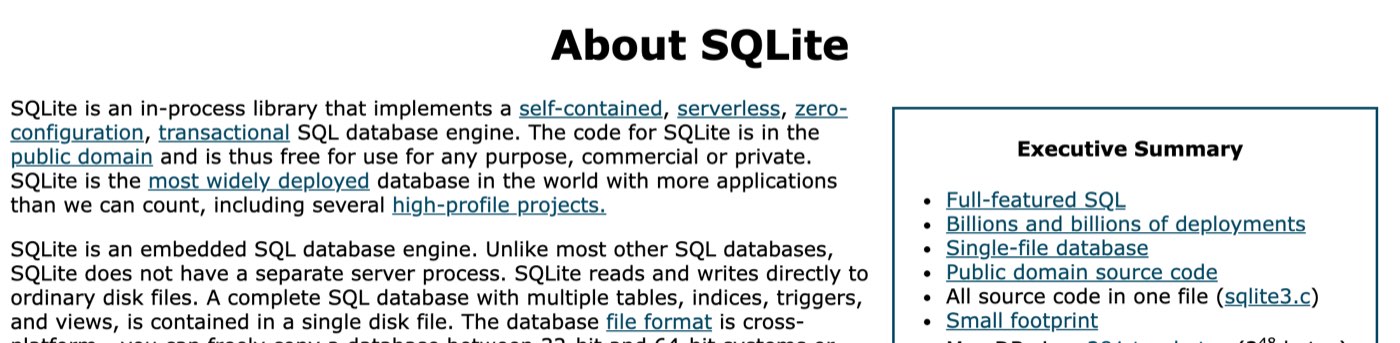
sqlite.org's About page on October 14, 2026: a full DBMS in a library, with no server to run.
How these tests were run
All on 14 October 2026, with SQLite 3.53.4 through Python 3.12.4's built-in sqlite3 module, on an Apple M2 Mac. One million rows were generated with a fixed random seed and written both to a CSV file and to a SQLite table. Each test looked up the same 200 emails and reports the median of three rounds. The CSV figure was measured on 20 lookups and multiplied by ten, because each lookup re-reads the file from the start.
The constraint test inserted a duplicate email and set a negative balance on a table with UNIQUE and CHECK constraints. The crash test ran the transfer in a separate Python process that called os._exit after the debit and before the commit, then reopened the database and read the balances. The script, its raw output and the summary in the screenshot are kept with the article's draft.
Frequently asked questions
What is DBMS in simple words?
The software that keeps an organisation's data in one place, finds any part of it quickly, refuses changes that break the rules, and makes sure a crash never leaves the data half-updated.
What is the full form of DBMS?
Database Management System. RDBMS is Relational Database Management System.
Is SQL a DBMS?
No. SQL is the language used to talk to relational DBMSs. MySQL, PostgreSQL, Oracle and SQLite are DBMSs that understand it.
Is Excel a DBMS?
No. A spreadsheet stores data in tables but does not enforce keys or constraints across users, has no transactions, and slows down long before a DBMS would. Our CSV test shows the gap: 153 milliseconds per lookup against 0.006.
Is MongoDB a DBMS?
Yes, a document-oriented NoSQL DBMS. It is a DBMS but not an RDBMS: data is stored as JSON-like documents rather than related tables.
What is the difference between a database and a DBMS?
The database is the data; the DBMS is the software that manages it. A MySQL server (the DBMS) can hold many databases.
Which DBMS should a beginner learn first?
Start with SQLite, because it needs no server and every concept here works in it, then move to PostgreSQL or MySQL, which most jobs and courses use. The SQL you learn carries across all three.
The Writeouts editorial desk for computer science fundamentals and tech careers: operating systems, databases and data structures explained clearly, and honest guides to roles like data analyst. From the Writeouts editorial team.
See everything by @learn-desk
0 comments
Sign in to join the discussion.
Loading comments…