Khan Academy is a free, nonprofit learning site and app with more than 840 courses, from Pre-K maths to early college, SAT prep, and NCERT and state-board classes for India. Everything on it is free, with no ads. The one thing it sells to individuals is Khanmigo, an AI tutor at $4 a month, and that is sold only in the United States.
This Khan Academy review checks the whole thing as of 23 October 2026, from Delhi: the prices on Khan Academy's own pages, its tax filings, the studies behind the line "Khan Academy works", and whether a lesson and a practice exercise open without an account. (They do.) Below: what it is, who made it, what it costs, what the evidence says, and where it falls short.
Khan Academy at a glance | Checked 23 October 2026 |
|---|---|
What it is | A 501(c)(3) nonprofit in Mountain View, California, running a free learning website and apps |
Who made it | Sal Khan; videos from 2006, nonprofit founded 2008 |
Price | Free. Khanmigo AI tutor $4 a month or $44 a year, US only. Schools pay $10 a student a year |
Size | 840+ courses, 227 million registered users, 104.9 million learners in the 2024–25 school year |
Languages | 55+, including Hindi, Hinglish, Gujarati, Kannada, Marathi and Punjabi |
Certificates | None for learners. Not an accredited school |
Android app | 4.4 stars from 1.74 lakh reviews, over 1 crore downloads, Editors' choice |
Money | Revenue $117.5 million in the year to June 2025, mostly donations |
What is Khan Academy?
Khan Academy is a nonprofit that publishes free video lessons, articles and practice exercises, organised into courses by grade and subject. Its stated mission, on the about page, is "to provide a free, world-class education to anyone, anywhere." The same page says it is available "in 190+ countries and in 55+ languages", with "840+ free courses covering core academic subjects for K-12 and early college".
A course is a chain of short videos, each followed by practice questions with hints and a worked solution. The practice is the point. A skill counts as mastered only after you answer correctly across quizzes and a unit test. The subjects, from the site's own menu: maths from pre-kindergarten to college, science, computing, arts and humanities, economics, reading and language arts, life skills, and test prep.
It is big. Ahrefs counts about 1.6 million Google searches a month for the name in the United States and 396,000 in India. The about page reports 227 million registered users, and 104.9 million people who used it in the 2024–25 school year. Visiting from India, the site shows a different front page: NCERT maths for Class 1 to 12, NCERT science for Class 6 to 12, bridge and revision courses, and separate tracks for the Karnataka, Maharashtra and Telangana boards.
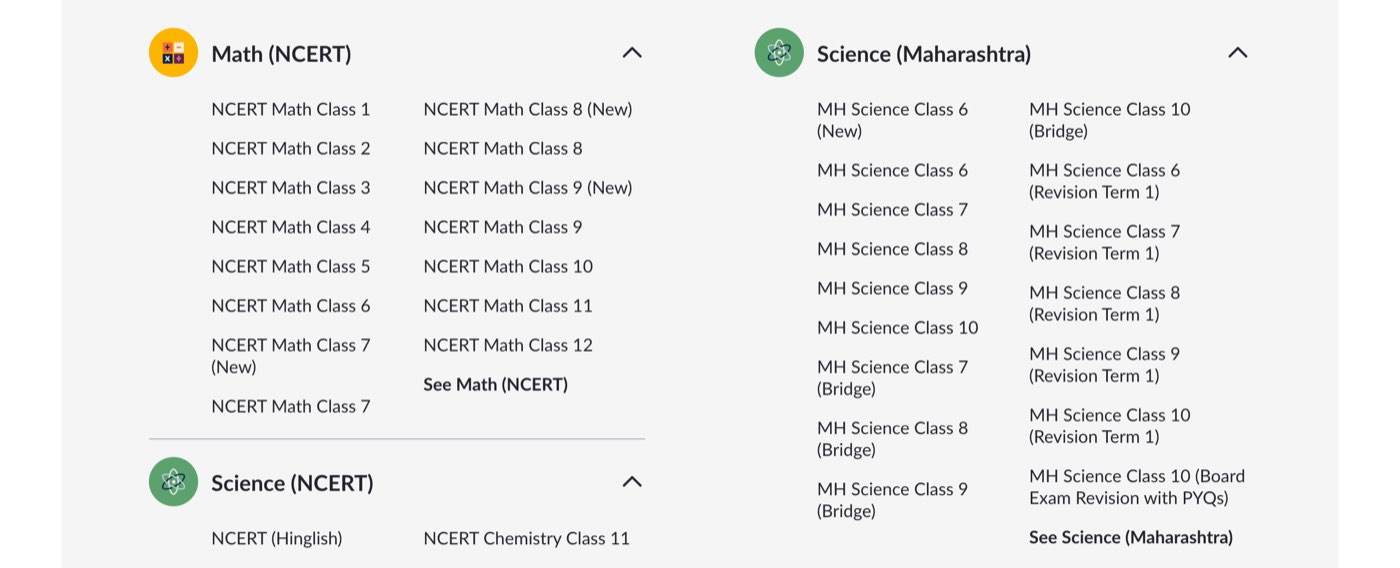
The course menu on khanacademy.org on October 23, 2026, seen from India: NCERT maths for every class, and board-specific science with bridge and revision versions.
Is Khan Academy free?
Yes. Every course, video, exercise and quiz on Khan Academy is free, there are no ads, and there is no premium tier of lessons. The organisation runs on donations. Its donation page says "Khan Academy is supported by less than 1% of users", and promises "no ads, no paywalls, and no pressure".
Three things do cost money, and none of them is the lessons:
Product | Who it is for | Price | Where |
|---|---|---|---|
Khan Academy courses, videos and practice | Anyone | Free | Worldwide |
Khan Academy Kids app (ages 2–8) | Families and teachers | Free, no ads, no subscriptions | Worldwide |
Khanmigo AI tutor (Learner or Parent plan) | Adults, or parents for up to 10 children | $4 a month or $44 a year, plus sales tax | United States only |
Khanmigo Teacher Tools | Teachers | Free | US and listed locales |
Khan Academy Districts (Enterprise Starter) | Schools, up to 1,000 students | $10 a student a year | US schools |
Khan Academy Kids for Schools | Schools and districts | $5 a student | Schools |
The prices come from the Khanmigo parents page, the districts pricing page and the Kids pricing page, all read on 23 October 2026.
A help article on the Khanmigo plans spells out the limit. The "$4 / month Khanmigo Learner Subscription" and the parent plan are each "Only available in the United States". The "Free Teacher Tools Subscription" is for "teachers in the United States and these specific locales across the globe".
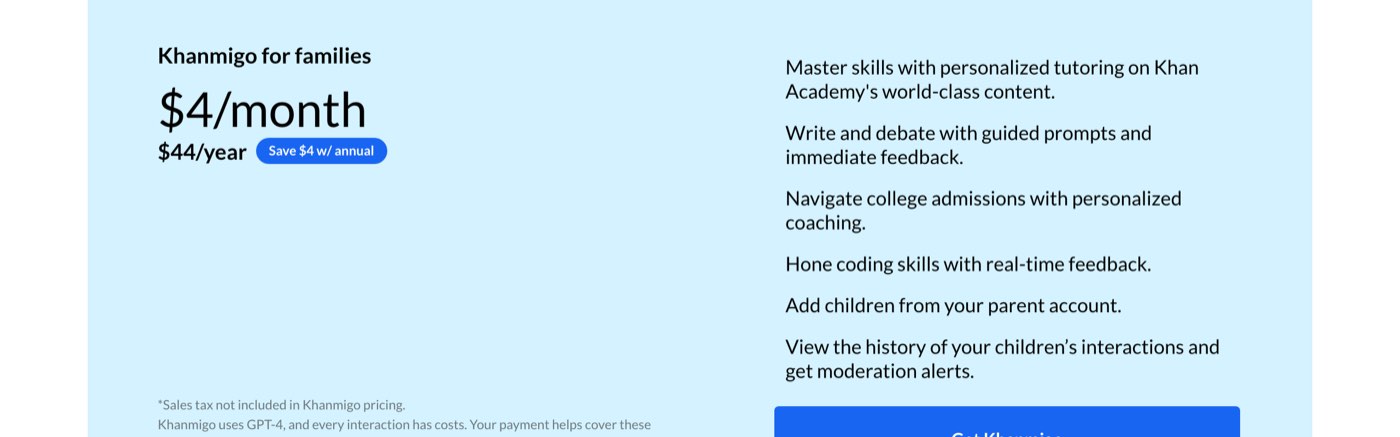
Khanmigo's price on khanmigo.ai on October 23, 2026: $4 a month or $44 a year before sales tax. The small print says "Khanmigo uses GPT-4, and every interaction has costs."
Do you need an account to use Khan Academy?
No. Lessons and exercises work without signing in; an account only saves your progress. We tested this on 23 October 2026 in a fresh browser with no Khan Academy account and optional cookies declined. The video page for "What is a variable?" loaded its player with no login wall. (The player is a YouTube embed on the privacy-enhanced youtube-nocookie domain.) The practice page "Evaluating expressions with one variable" showed a problem and took our answer of 14. About two seconds after we pressed Check, it replied "Nice work! You got it. Onward!"
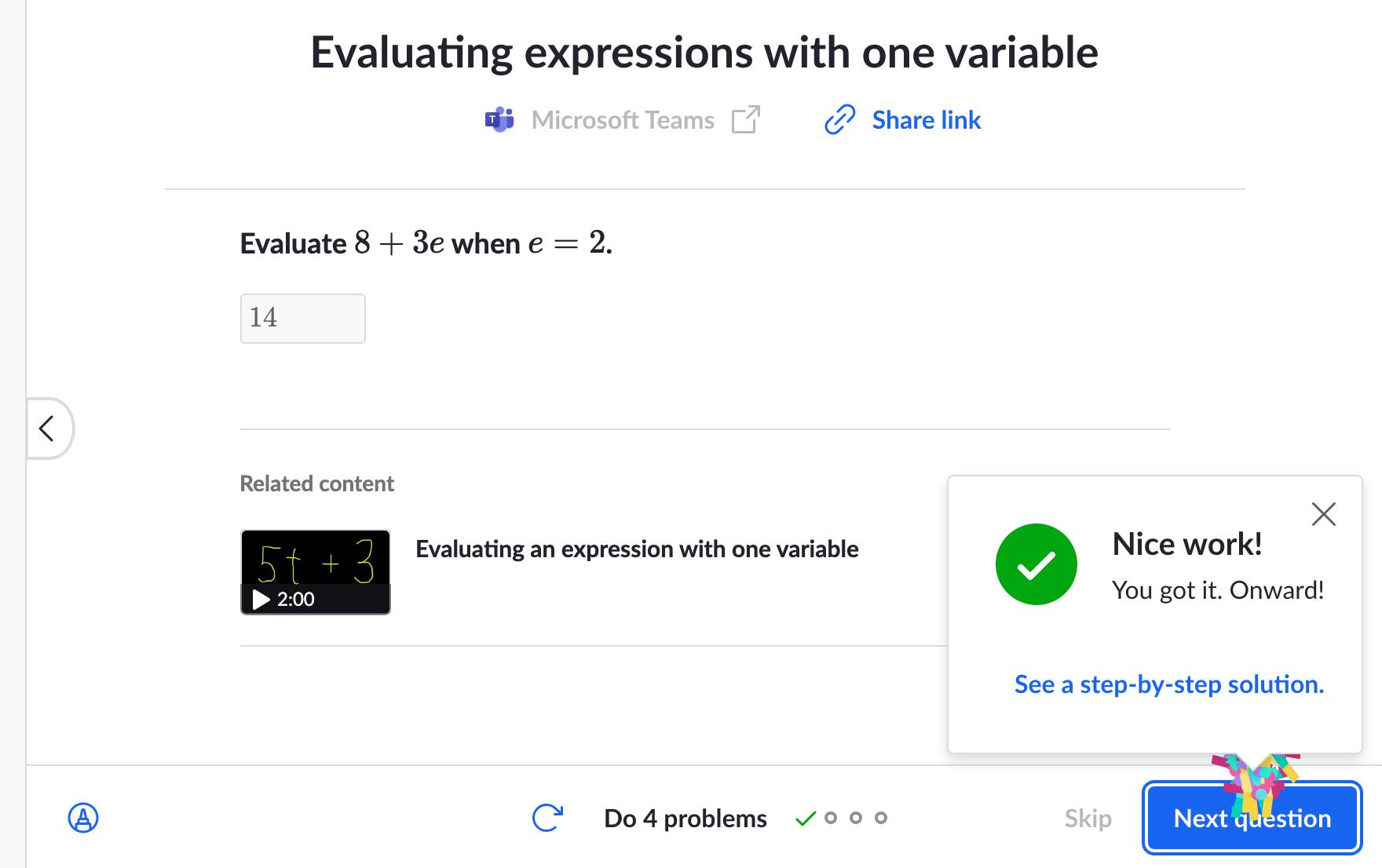
The Algebra 1 exercise "Evaluating expressions with one variable" on October 23, 2026, answered from a browser with no account. The correct answer was accepted and a step-by-step solution offered, with no sign-up prompt.
What you lose without an account is the mastery tracking, the course challenge that lets you skip what you already know, and the teacher and parent dashboards. Signing up is free. Children under 13 enter a parent's email, and the parent has seven days to approve the account. The "khan academy login" page is khanacademy.org/login, and the common misspelling "Kahn Academy" reaches the same site through Google.
Who made Khan Academy?
Salman "Sal" Khan, an American born in 1976 in Metairie, Louisiana, with degrees from MIT and an MBA from Harvard. His Wikipedia biography dates the start to 2004, when he began tutoring his cousin Nadia in maths over the internet while working as a hedge-fund analyst. He opened a YouTube account on 16 November 2006 to hold the videos, and left finance in late 2009 once the channel had taken off. Khan Academy's press page dates the organisation itself: "Sal Khan founded Khan Academy in 2008."
It is a registered charity, not a company. The US tax record on ProPublica's Nonprofit Explorer lists Khan Academy Inc of Mountain View, California, EIN 26-1544963, with 501(c)(3) status granted in May 2008. Its founding partners are Ann and John Doerr, the Bill and Melinda Gates Foundation, Google, Reed Hastings, Fundação Lemann, the O'Sullivan Foundation, Fundación Carlos Slim, Tata Trusts and the Valhalla Foundation. Elon Musk's foundation gave $5 million in 2021.
The money is public because charities file it. For the year ending June 2025, the Form 990 shows revenue of $117.5 million, expenses of $87.5 million and net assets of $152.2 million. Sal Khan's pay as CEO was $871,261. ProPublica's year labels switch from December to June at that point, so the "June 2024" line, at $28.1 million, covers a short transition period rather than a full year.
Is Khan Academy good? What the studies show
For school maths, yes, and it is one of the few free learning sites with peer-reviewed evidence behind it. The effect is modest and depends on how much a student actually practises. Here is the evidence, with the caveats attached.
A national study in PNAS (January 2026). Researchers from Stanford and the University of Toronto, including Stanford's Emma Brunskill, analysed about 200,000 students across hundreds of US districts over three years. Khan Academy's summary reports "a significant effect on learning outcomes" when a teacher's class uses it more. It also admits average use was only "10-15 minutes per week", half the recommended 30. The paper (DOI 10.1073/pnas.2507708123) is paywalled, and the post gives no effect size, so read it as "real", not "large".
Newark, three years. Khan Academy's own study followed about 8,000 students in 13 Newark schools. It found "about a one-point gain" on New Jersey's state test for every 10 extra skills mastered. Sixty extra skills in a year is worth six to eight points, against a state-average gain of about two. The authors admit the design cannot rule out "other things that change over time".
The SAT claim. In May 2017 the College Board reported that 20 hours on Official SAT Practice was "associated with an average score gain of 115 points". That is a correlation from the paper-SAT era. Students who did zero hours still gained 60 points on average, so treat 115 as the top of the range, not the expectation.
The AI tutor, tested properly. A two-year randomised trial in 18 Tennessee middle schools, circulated by the NBER in August 2026 as working paper 35620, found Khanmigo raised maths achievement by about 1.26 national percentile ranks a term. The authors say the gain "resembles those from Khan Academy practice without AI assistance". Most students barely used the tutor, and only 14.5% of their messages contained a maths question or a reasoning step.
Learners say the same thing in plainer words. A self-study guide on r/learnmath from February 2026, by someone who spent two years learning maths and physics alone, calls the Algebra Foundations course "absolutely amazing". It is "especially good at structuring explanations in a way that makes things conceptually click", and the guide's recommended order is "Khan Academy → Professor Leonard". On Google Play, the review with the most helpful votes on the Indian listing reads: "It's great that they are offering education completely free. I appreciate the absence of ads."
Where it is weaker: maths and the sciences are deep; the humanities and computing courses are introductions. There is no live teacher and no classmates. And the whole model relies on the student turning up, which is the limiting factor every study above ran into.
Is Khan Academy accredited, and does it give certificates?
No, on both counts. Khan Academy's help centre says it plainly: "Khan Academy is not an accredited school and work done on the site does not count towards a diploma or degree program." The only certificates it issues are teacher-training certificates (the Khan for Educators course in India ends with one) and LearnStorm certificates for classroom challenges. Nothing you complete as a learner can go on a CV as a qualification.
That is a design choice, not a gap. Khan Academy is "best used as a supplement to your normal schooling", in the help centre's words. If you need a credential, do the learning here, then sit the exam or take the course somewhere that is accredited.
Is Khan Academy legit, and is it a reliable source?
It is legitimate: a US charity since 2008 with public accounts, the College Board's only official SAT partner, and more than 600 partner school districts. Its Android app on Google Play declares "No data shared with third parties", is rated for ages 3 and up, and was last updated on 13 August 2026.
On reliability, Khan Academy's content policy says courses "are created by experienced content specialists, many with advanced degrees in their fields", and that outside experts review them. Where large language models help with drafting, "every piece of AI-assisted content is carefully reviewed, edited, and approved by our content team before publication". Errors do get through. The corrections system adds "a small text box in the lower right-hand corner" of a video, which the help page warns "are not visible in full-screen mode".
For a school or college essay, the answer is different. Khan Academy is a teaching resource, like a textbook. Use it to understand a topic, then cite the primary source it is explaining, because most teachers will not accept a tutorial video as a reference.
What is Khanmigo, and is it worth $4 a month?
Khanmigo is Khan Academy's AI tutor, launched in March 2023. It answers questions about the lessons by asking questions back rather than handing over the answer. The parents page says it "uses GPT-4". A 2024 engineering post describes moving parts of it to GPT-4 Turbo and sending arithmetic to a calculator, after the Wall Street Journal found it making basic calculation errors. Since January 2026 the separate Writing Coach runs on Google's Gemini, per Google's announcement.
The price is $4 a month or $44 a year plus sales tax. The buyer must be 18 or older, live in the United States and have a US billing address. One parent plan covers up to 10 children. Teachers get a free Teacher Tools plan, and students in partner districts get it through school at $10 a student a year.
Worth it? For a US family whose child will actually talk to it while doing Khan Academy practice, $44 a year is cheap for a tutor that never tires. The Tennessee trial is the honest check: the gains were real but no bigger than plain Khan Academy practice, because most students did not engage. If your child already works through the free exercises, the tutor adds a patient explainer. If they do not, it adds nothing. Outside the US, the question does not arise, because you cannot buy it.
Khan Academy in India: NCERT, boards and Hindi
Khan Academy India is a separate Section 8 nonprofit, "supported by Tata Trusts and CSF" according to its Play Store listing. Its site at india.khanacademy.org promises "100% free content for Grade 1-12, aligned to India curriculum". The Indian front page of khanacademy.org carries NCERT maths for Class 1 to 12 and NCERT science for Class 6 to 12. It adds courses mapped to the Karnataka, Maharashtra and Telangana boards, English grammar, computer science and economics. Revision courses for Class 10 and 12 include previous years' board questions.
Languages: the India site lists English, Hinglish, Hindi, Gujarati, Assamese, Odia, Marathi, Punjabi and Kannada. The Hindi site at hi.khanacademy.org has UP Board and CBSE maths and science for Class 1 to 12. The app's description says the middle and high school content has been "translated to Hinglish" for students taught in English who think in Hindi.
The Android app, which works offline once you download a lesson, has 4.4 stars from 1.74 lakh reviews and more than 1 crore downloads, with a Google Play Editors' choice badge. Teachers can take the free Khan for Educators training, which does end with a certificate. What India does not get is Khanmigo. There is a long-running community request for it, and no launch date.
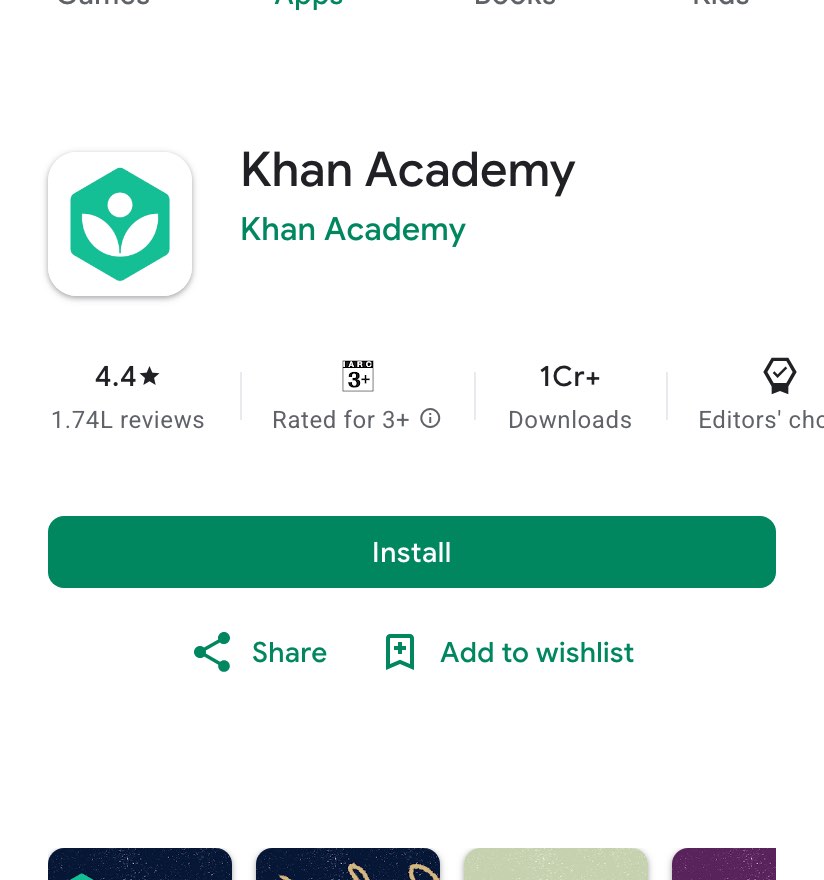
The Khan Academy app on Google Play in India, October 23, 2026: 4.4 stars from 1.74 lakh reviews and more than 1 crore downloads. The developer name to look for is "Khan Academy".
Khan Academy Kids: free for ages 2 to 8
Khan Academy Kids is a separate app for children aged two to eight, built with learning experts at Stanford. It covers early reading, phonics, writing, counting and social-emotional skills through games and a library of books. The Kids page calls it "100% free - forever" with "No ads, no subscriptions", and the Play Store listing repeats "No ads, no subscriptions — ever." It is rated 4.4 stars from 57,300 reviews with more than 1 crore downloads, carries Google's Teacher Approved badge, and was updated on 26 September 2026. Schools that want web reporting and training pay $5 a student; families and single classrooms pay nothing.
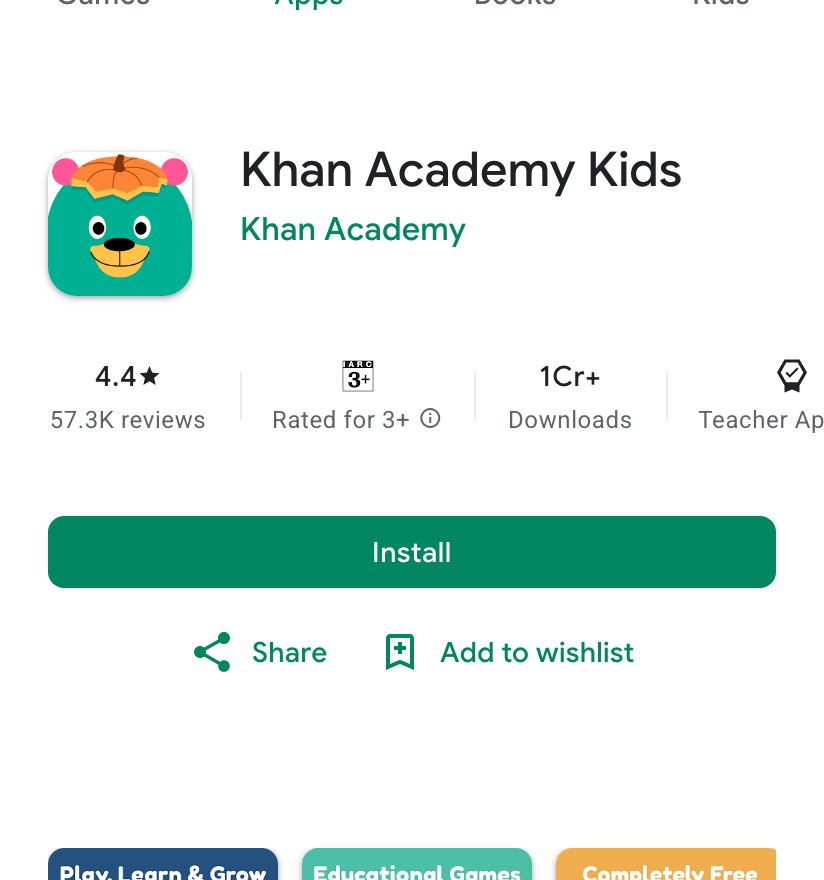
Khan Academy Kids on Google Play in India, October 23, 2026: the same developer, a Teacher Approved badge, and no in-app purchases listed.
Khan Academy SAT prep: what is free and where the tests are
Khan Academy is the College Board's only official SAT partner, and its SAT page says every piece of prep is free: "Access all of our SAT prep materials for free—anytime, anywhere." When the SAT went digital in 2024, the old Official SAT Practice product was retired. A help article says it was replaced by two courses, Digital SAT Math and Digital SAT Reading and Writing, with thousands of practice questions, videos and lessons.
The full-length practice tests are not on Khan Academy. The page's two-step plan is "Take a full-length practice test on College Board's site" in the Bluebook app, then "Learn and practice your skills on Khan Academy". Set expectations with the 2017 figures above: practice helps, and 115 points was the average for the most diligent group on the old test.
Is Khan Academy worth it?
Yes, for anyone learning school or first-year college maths and science, preparing for the SAT, or filling gaps as an adult. It costs nothing, carries no ads, has studies behind it, and needs no account to try. The free site is the product; Khanmigo is an optional $4 add-on for US families. It is not the right tool if you need a certificate, a live teacher, or depth in programming, humanities or professional skills. A university course or a specialist platform fits those better.
Good for | Look elsewhere for |
|---|---|
School maths from Class 1 to calculus, with practice that tracks mastery | A qualification: Khan Academy is not accredited and issues no learner certificates |
NCERT and state-board revision in Hindi, Hinglish and regional languages | Live classes, doubt-clearing with a teacher, or classmates |
Digital SAT practice, free and official | Advanced programming: the computing courses are introductions (our guides to data structures and APIs pick up where they stop) |
Children aged 2 to 8, through the Kids app | An AI tutor outside the United States |
Adults rebuilding fundamentals in maths, finance or statistics | Professional or career skills such as design or marketing |
How this was checked
Everything above was read or tested on 23 October 2026 from a home connection in Delhi. Prices and quotations come from Khan Academy's own pages: the about, SAT, districts pricing, Kids and Kids pricing pages, the Khanmigo parents page, and the Help Center articles linked where they are quoted. Finances are from the Form 990 filings published on ProPublica.
The studies are linked where they are described. The PNAS and NBER papers are the independent ones; the Newark study and the SAT figures are Khan Academy's and the College Board's own. The no-account test used a headless Chromium browser with no cookies accepted, and the script and its results are kept with this article's draft. Khan Academy's annual-report site refuses automated browsers, so its figures are taken from the about page instead.
Frequently asked questions
Is Khan Academy free?
Yes. All courses, videos and practice exercises are free with no ads. The only paid products are the Khanmigo AI tutor ($4 a month, US only) and school-district plans.
What is Khan Academy?
A US nonprofit, founded in 2008 by Sal Khan, that runs a free learning site and apps with more than 840 courses in maths, science, computing, humanities, economics and test prep, in over 55 languages.
Who made Khan Academy?
Sal Khan, a former hedge-fund analyst with MIT and Harvard degrees, who started by tutoring his cousin online in 2004 and posting videos to YouTube from 2006.
Is Khan Academy good for maths?
Yes. Maths is its strongest subject, and a 2026 study in PNAS of about 200,000 students found higher test-score growth when classes used it more.
Is Khan Academy accredited?
No. It is not an accredited school, and its work does not count toward a diploma or degree. It issues no certificates to learners, only to teachers who complete its training.
Is Khan Academy a reliable source?
For learning, yes: its content is written by subject specialists and reviewed, and errors are corrected on screen. For an essay, cite the primary source it explains, not the video.
How much does Khanmigo cost?
$4 a month or $44 a year plus sales tax, for buyers aged 18 or over with a US billing address. One parent plan covers up to 10 children. Teachers get a free plan.
Is Khan Academy available in Hindi?
Yes. hi.khanacademy.org has UP Board and CBSE maths and science in Hindi, the app has Hinglish versions of middle and high school content, and the India site lists Gujarati, Marathi, Punjabi, Kannada, Assamese and Odia too.
Does Khan Academy work offline?
The Android app lets you download videos and exercises to use without a connection. The website needs internet.
The Writeouts editorial desk for computer science fundamentals and tech careers: operating systems, databases and data structures explained clearly, and honest guides to roles like data analyst. From the Writeouts editorial team.
See everything by @learn-deskEdited by Rajat Chauhan. How articles here are written and edited.
0 comments
Sign in to join the discussion.
Loading comments…