A ChatGPT prompt is whatever you type, paste, speak or attach to tell ChatGPT what you want. OpenAI's own prompting guide, read on 26 October 2026, says a good one states the goal, adds context, names the output and sets boundaries, with no rigid formula. Below: that formula, a test of it in ChatGPT, 40 prompts you can paste, the viral 1980s photo prompt, and ChatGPT's India prices.
Everything here was read on 26 October 2026 from Delhi, and four of the prompts were sent to ChatGPT the same day without an account. The sources are OpenAI's ChatGPT Learn guide, its help-centre articles, its pricing page and its release notes, plus the pages Google currently cites for this search. The prompts are written for Indian readers but work anywhere, and most of them work in Gemini and Claude too.
ChatGPT prompts at a glance | Checked 26 October 2026 |
|---|---|
What a prompt is | A question, instruction or goal in your own words, plus any file, image or audio you attach |
OpenAI's formula | Goal, context, output, boundaries. "Use only the parts that help" |
Cost | Free at ₹0 with unlimited text chats on GPT-6; Go ₹399, Plus ₹1,999, Pro from ₹10,699 a month in India |
Account | Text chats work signed out on the web, as we did; images, uploads, memory and chat history need an account |
Tested | Four prompts sent signed out from Delhi on 26 October 2026; the four-part prompt got exactly the format and facts it asked for |
Prompt length | About 12 pages of input on Free, 40 on Go and Plus, 250 on Pro, per OpenAI's pricing page |
Photos | Image creation is limited on Free; OpenAI's 1980s prompt and the caricature prompt are below |
Where to get prompts | The 40 below, the prompts.chat library, or ask ChatGPT to write the prompt for you |
Model | GPT-6 Luna on Free and Go, GPT-6 Sol on Plus and Pro, since 7 and 8 October 2026 |
What is a ChatGPT prompt?
A ChatGPT prompt is the input that starts or steers a conversation with ChatGPT. OpenAI's help centre defines it as "a text input that initiates a conversation or triggers a response from the model". It adds that "it can be in other forms such as an image or audio". Its ChatGPT Learn guide says the same in plainer words: "A prompt can be a question, an instruction, or a goal."
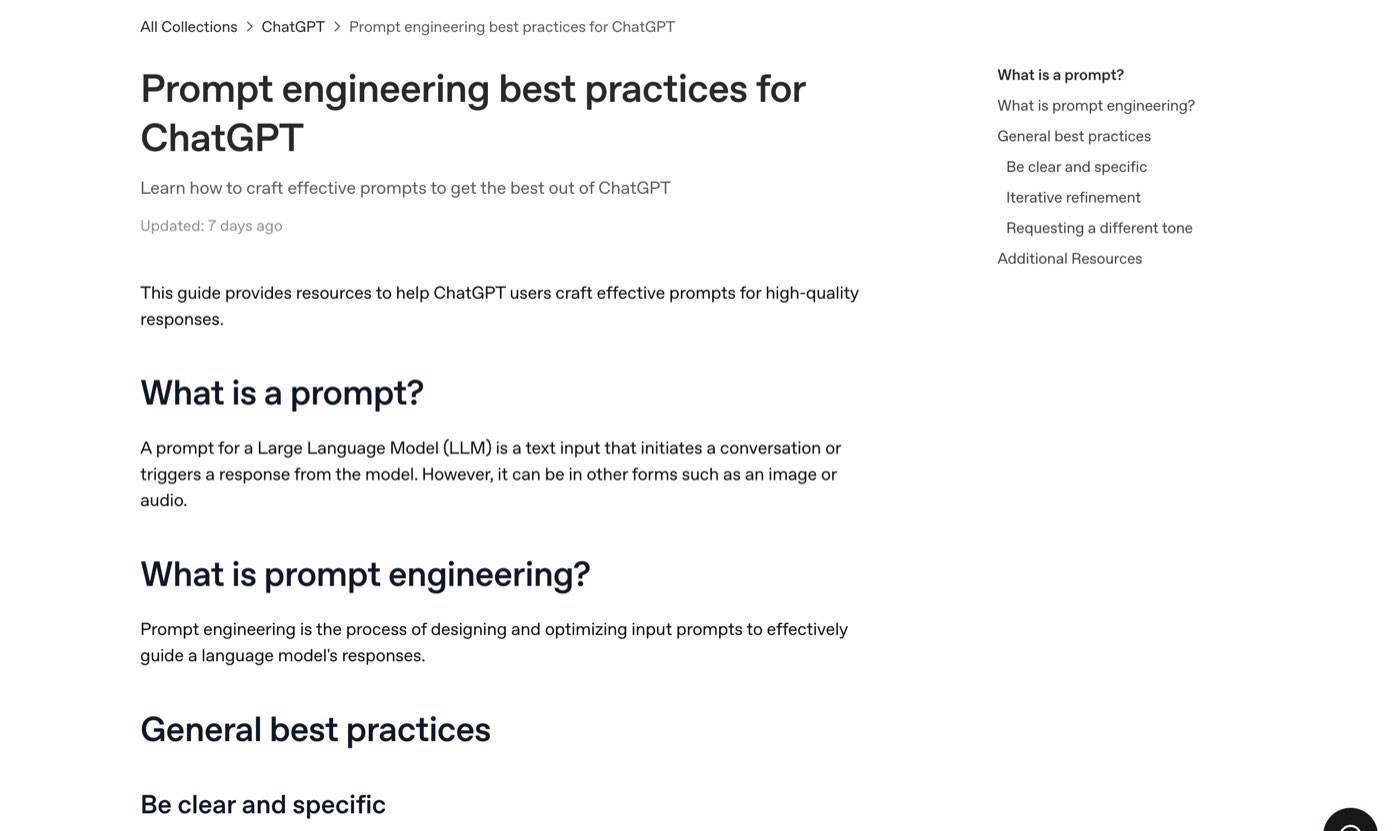
OpenAI's help-centre definition of a prompt, read on October 26, 2026, a week after its last update.
The wording matters because the model has no idea what you meant to say. OpenAI Academy's prompting resource, updated on 4 September 2026, explains why. "Because LLMs do not 'know' things in the way people do, how you phrase your prompt plays a big role in shaping the response." Prompt engineering, in the help centre's definition, is simply "the process of designing and optimizing input prompts to effectively guide a language model's responses".
None of this needs special syntax. OpenAI's older help article on creating a good prompt says to write as if you were briefing a person. Name the task, give the context, set the tone, and split big jobs into smaller prompts. The best ChatGPT prompts are not clever tricks. They are clear briefs.
How to write a ChatGPT prompt: OpenAI's four parts
The best ChatGPT prompt states four things, according to OpenAI's ChatGPT Learn guide as read on 26 October 2026: the goal, the context, the output you want and the boundaries. In the guide's words: "You don't need technical syntax or a rigid formula. Start in your own words, review the response, and use follow-up messages to shape the result." A short prompt "is often enough" for small tasks.
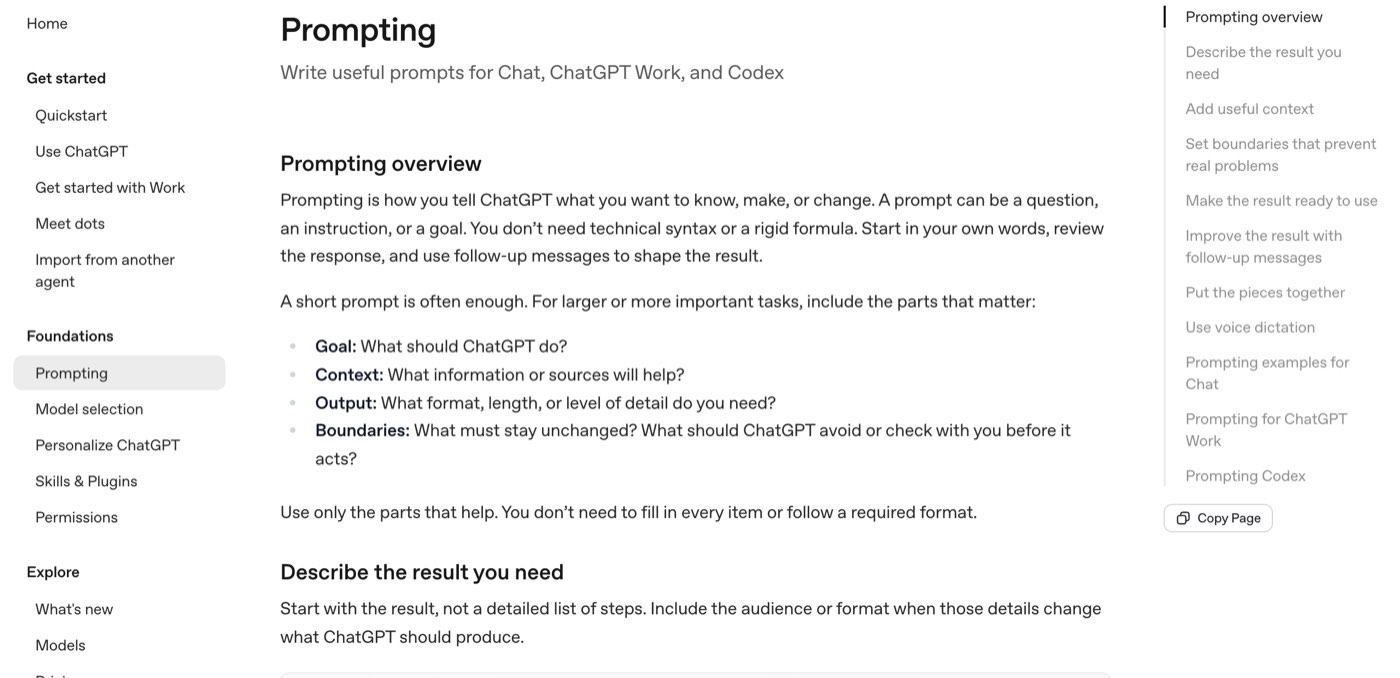
OpenAI's ChatGPT Learn prompting guide on October 26, 2026: four optional parts, and "use only the parts that help".
Goal: "What should ChatGPT do?" The guide says to "start with the result, not a detailed list of steps", and to name the audience or format only when it changes the answer.
Context: "What information or sources will help?" Paste the text, attach the file, or tell it to search the web when the answer depends on today's facts.
Output: "What format, length, or level of detail do you need?" Say how you will use it: a one-page summary, a follow-up email, a table.
Boundaries: "What must stay unchanged? What should ChatGPT avoid or check with you before it acts?" The guide's examples include "Use only the supplied sources. Flag missing information instead of guessing."
The other pages Google cites add two optional parts. Coursera's guide, updated on 14 March 2026, adds a role for ChatGPT to play and an example of the output you want. OpenAI's own API prompting article agrees on examples: "the models respond better when shown specific format requirements". The role matters less than it did. Matt Wolfe's prompting video, which Google also cites, says assigning a job title "has gotten less and less important over time".
Here is the difference in practice. The weak prompt leaves every decision to the model; the better one makes them for it.
Weak: "Write a product description for a steel water bottle."
Better: "You are a copywriter for a small Indian D2C brand. Write a product description for a 1-litre insulated steel water bottle sold on Amazon India for ₹899. Audience: office workers and college students. Format: a two-line hook, four short bullet points, then one line on the one-year warranty. Tone: plain, with no words like premium or ultimate. Under 90 words. Use only these features: keeps water cold for 24 hours and hot for 12, leak-proof lid, fits a car cup holder, weighs 480 g."
The second prompt has a goal (a description) and context (the product, its price and its buyer). It also has an output (a hook, four bullets and a word limit) and boundaries (no hype words, only the listed features). That last line follows a rule from OpenAI's API prompting article: "Instead of just saying what not to do, say what to do instead." The same article tells you to drop "fluffy" length words and write "Use a 3 to 5 sentence paragraph" rather than "fairly short".
Does a better ChatGPT prompt change the answer? We tested it
Yes, and the difference is easy to see. On 26 October 2026 we sent both water-bottle prompts to chatgpt.com from Delhi, in a fresh browser with no account, each in a new chat. The weak prompt came back as a titled "Writing" block of about 165 words, headed "Premium Stainless Steel Water Bottle", with six bullet points and a closing slogan. It invented what it was not told: a "leak-resistant lid", "eco-friendly" credentials and travel use.
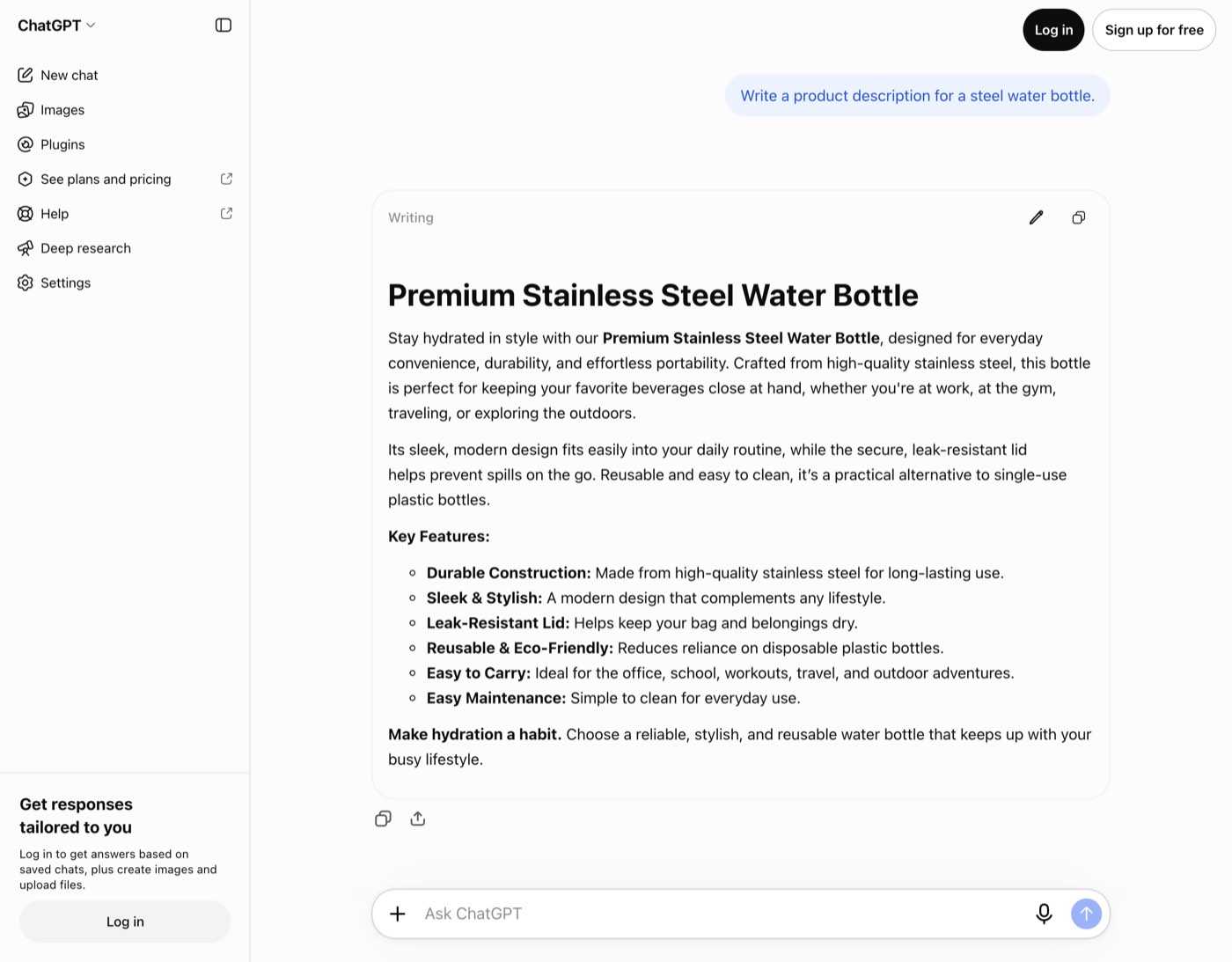
The weak prompt in ChatGPT on October 26, 2026: an invented title, invented features and about 165 words.
The four-part prompt came back as about 65 words in exactly the shape requested: a two-line hook, "Your water, at the right temperature", four bullets and a warranty line. Every fact in it was one we supplied: 24 hours cold, 12 hot, the leak-proof lid, the cup holder, 480 g. Nothing was invented, and "premium" did not appear. The price, which we gave as context but did not ask it to mention, was left out, which is the right call for a description.
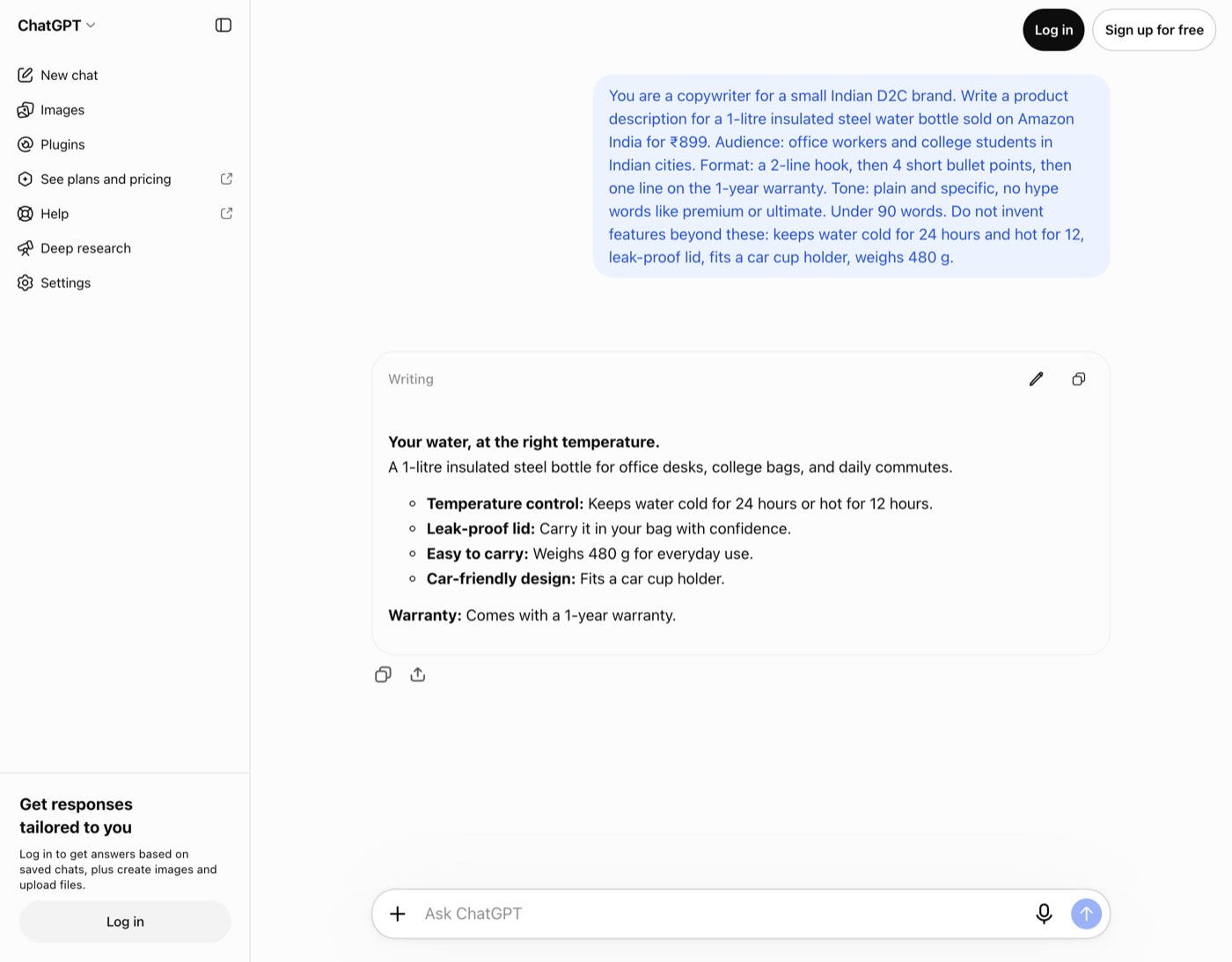
The four-part prompt in ChatGPT on October 26, 2026: four bullets, only the facts supplied, no hype words.
Two smaller tests are described in the sections that follow: asking ChatGPT to write a prompt, and asking it to rewrite marketing copy like a person. Signed out, the page shows no model name, so we cannot say which GPT-6 variant answered. The screenshots, the script and the results file are kept with this article's draft, as described under "How this was checked".
How to use a prompt in ChatGPT
To use a prompt in ChatGPT, open chatgpt.com or the app, type or paste the prompt into the box marked "Ask ChatGPT", and press Enter. You do not need an account for a text chat on the web: OpenAI's release notes of 7 August 2026 describe "the signed-out experience on the web", and our four test prompts were sent that way. Signing in adds uploads, images, memory and your chat history. The steps below are OpenAI's own, from the same release notes and its Learn guide.
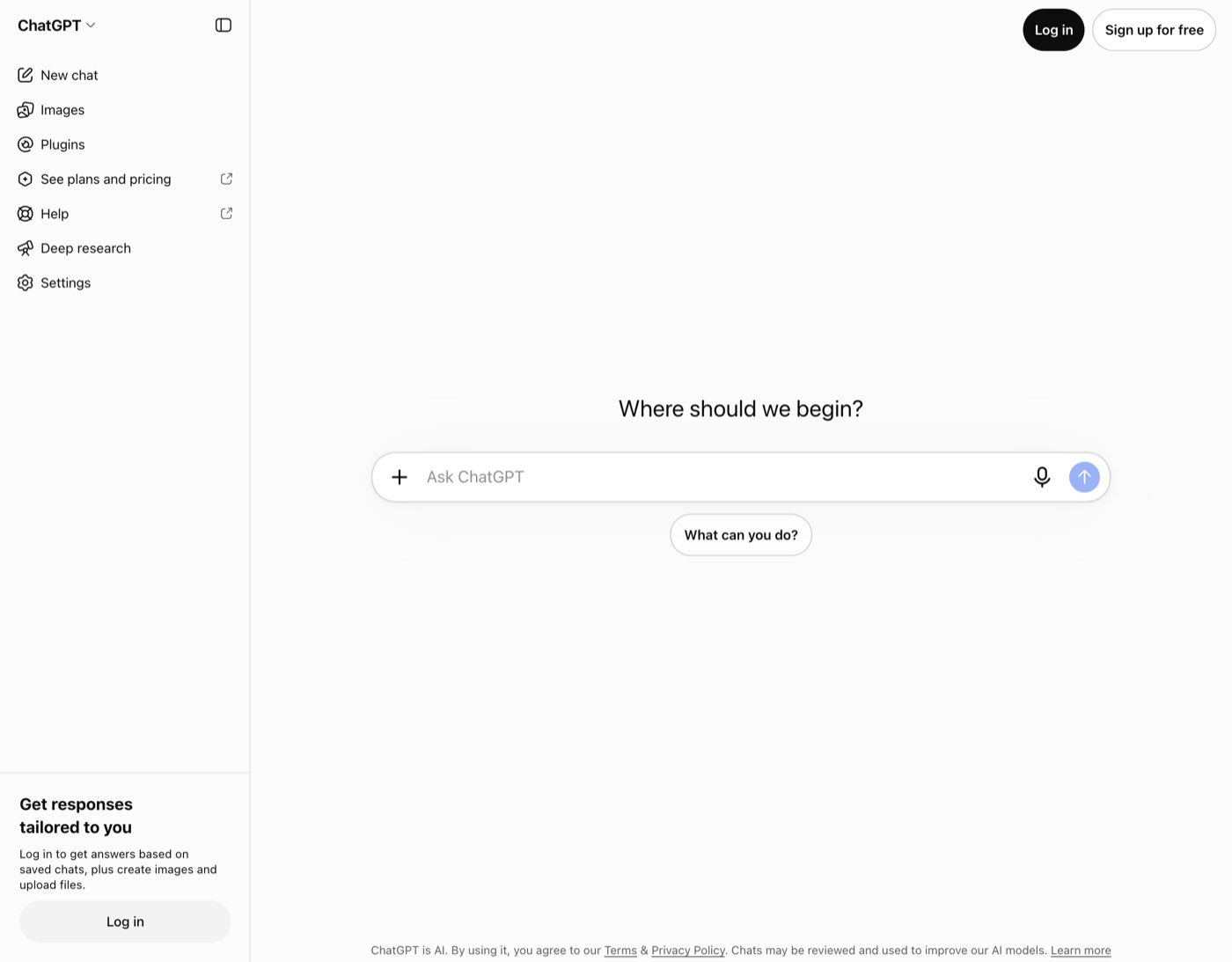
chatgpt.com signed out on October 26, 2026: a working prompt box, no login wall, and OpenAI's own banner for the 1980s photo trend.
Put the instruction first, then the material. OpenAI's API article recommends a line such as Text: """ before pasted text and """ after it, so the model knows where your instruction ends.
Attach what the task needs. Files, screenshots and audio go in with the plus button, with limits on the Free plan. Type @ in the composer to pick a plugin such as Google Drive or Gmail, per the Learn guide.
Press Enter and read as it writes. Since the GPT-6 release of 7 October 2026, ChatGPT "can begin answering while it continues to think or use tools".
Follow up instead of starting over. The Learn guide's example: "Make the opening more direct, keep the evidence, and move the recommendation above the background section." You can also edit your message, with attachments, to revise the prompt, a change from June 2026.
Press Think for hard questions. Free and Go users got a Think button in August 2026. OpenAI Academy says phrases like "think carefully" or "think harder" also trigger more effort.
Save what works. Put standing preferences in Settings, then Personalization, as custom instructions. Free users can also keep up to three scheduled tasks running, per the release notes of 25 August 2026.
How to create a prompt in ChatGPT, or get ChatGPT to write it
You can create a prompt in ChatGPT in under a minute by asking for one. "Write me a prompt I can paste into ChatGPT to get a 7-day revision plan for the Class 12 CBSE physics board exam. Give only the prompt, nothing else." Coursera's guide recommends exactly this, both to save time and to learn what a strong prompt looks like. OpenAI offers the same idea to developers as a "Generate Anything" feature in its API tools.
We sent that exact request to ChatGPT signed out on 26 October 2026. It returned only a prompt, as asked, but a long one: it opens "Act as an expert CBSE Class 12 Physics teacher, board-exam strategist, and study planner", then lists numbered instructions. Those cover the current syllabus, a day-by-day timetable with study sessions, the high-scoring chapters from electrostatics to semiconductor electronics, and derivations, diagrams and formulas. Trim what you do not need before pasting it back in.
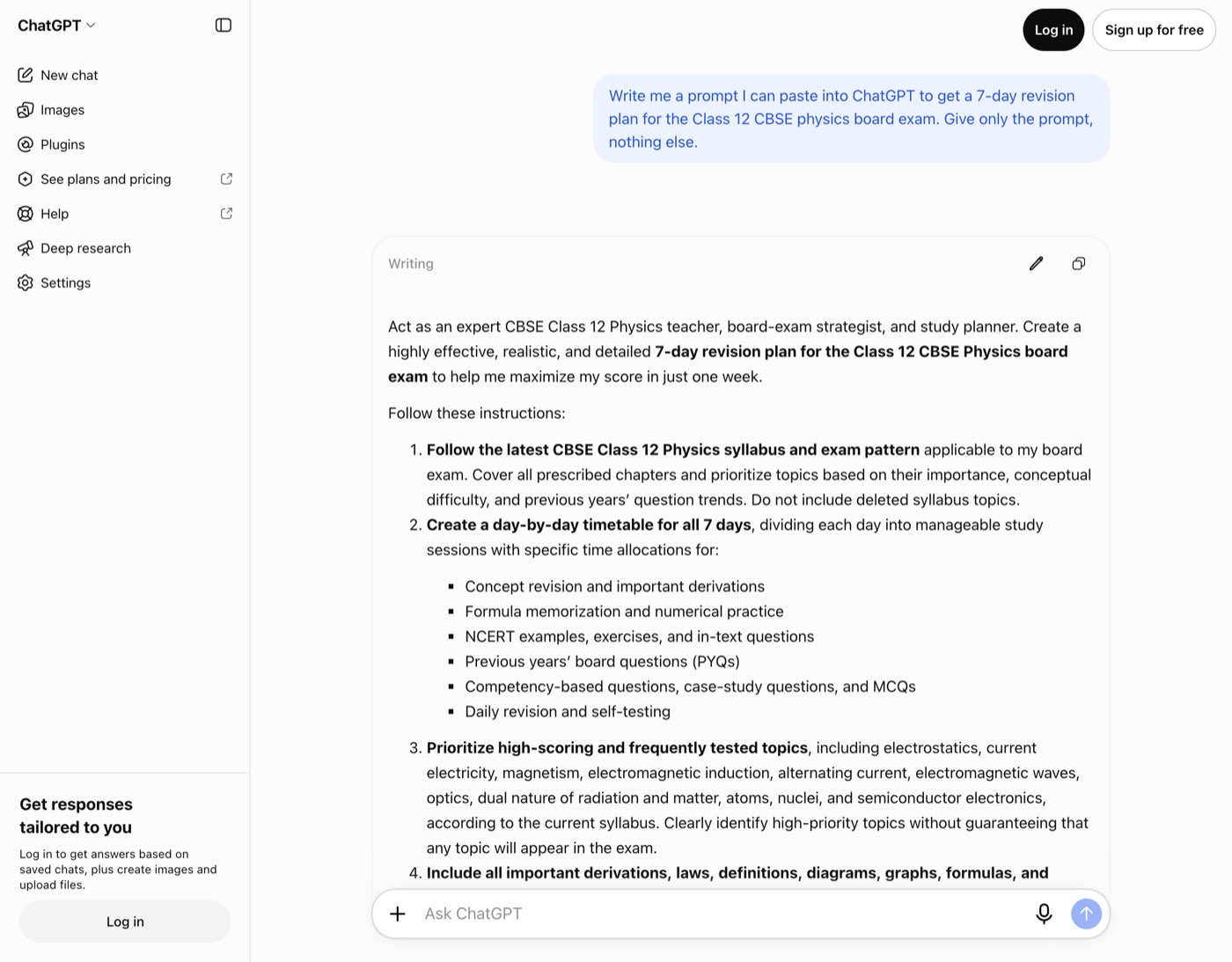
ChatGPT writing a prompt on request, October 26, 2026: a role line, then numbered instructions for the next chat to follow.
For a reusable template, and for anyone asking how to make a prompt in ChatGPT from scratch, fill in the four parts from OpenAI's guide on one line each. Goal: what to make. Context: paste or attach the material. Output: the format, length and audience. Boundaries: what to leave alone and what to flag. A fifth line, "Example:", with a sample of what good looks like, is the single biggest upgrade for formatting tasks, per OpenAI's API article.
Three other sources rank for the search. The prompts.chat library on GitHub, formerly Awesome ChatGPT Prompts, has about 175,000 stars and thousands of "Act as" prompts. A four-year-old Reddit thread still ranks for its "prompt for all prompts", which turns ChatGPT into your prompt engineer and has it ask you questions until the prompt is right. And PrompTessor is a free ChatGPT prompt generator that needs no account; it turns a rough task into a structured prompt.
40 ChatGPT prompt examples, ready to paste
Each prompt below carries a goal, context, output and at least one boundary, following OpenAI's Learn guide. Replace anything in square brackets. They cover the five jobs Quillbot's guide says most prompts do: information, creation, revision, analysis and coaching.
Work and email
Reply to a client: "Draft a reply to the email below. Goal: confirm we can deliver by 15 November, ask for the purchase order number, keep it under 100 words, polite and plain. Do not promise a discount. Email: [paste]"
Meeting notes to update: "Turn these meeting notes into a short update for the project team. Put the decisions and next steps first, name an owner for each step, and flag any step with no owner. Notes: [paste]"
Sheet formula: "In my Google Sheet, order dates are in column A and amounts in column C. Write a formula for the total of amounts dated October 2026 and explain it in two lines."
Leave application: "Write a two-paragraph leave application to my manager for 3 to 5 December for a family wedding in Jaipur. Mention that Priya will cover my client calls. Formal but not stiff."
Self-appraisal: "Act as an HR writing coach. Turn these five bullet points about my year into a 150-word self-appraisal that states results with numbers and avoids boasting. Bullets: [paste]"
LinkedIn post: "Write a LinkedIn post under 120 words announcing that our team shipped [feature]. Start with the problem it solves, not the launch. No hashtags, no emoji, and do not use the word thrilled."
Study and exams
Revision plan: "Make a 7-day revision plan for Class 12 CBSE physics. I have 3 hours a day, I am weak in optics and electrostatics, and the exam is on [date]. Give each day as a table with topic, task and a 15-minute self-test."
Explain like a classmate: "Explain Kirchhoff's laws the way a good classmate would the night before an exam: one example circuit, both laws in plain words, and the commonest student mistake."
Practice quiz: "Give me 10 multiple-choice questions on fundamental rights in the Indian Constitution at UPSC prelims level, with the answer and a one-line reason after each."
Essay feedback: "Here is my 300-word essay for a college application. Do not rewrite it. List the three weakest sentences and say why each is weak. Essay: [paste]"
Flashcards: "Turn this chapter summary into 20 question-and-answer flashcards, one line each, hardest first. Summary: [paste]"
Hinglish: "Newton ke teen laws simple Hinglish mein samjhao, har law ke saath ek daily-life example do, aur end mein 3 short questions pucho."
Writing and rewriting
Write like a human: "Rewrite this so it reads like a person wrote it. Rules: no dashes, no bullet points, none of the words innovative, powerful, elevate or empower, mix short and long sentences, under 50 words. Text: [paste]"
Match my voice: "Here are three paragraphs I wrote. Describe my style in five points, then rewrite the text below in that style. My paragraphs: [paste] Text to rewrite: [paste]"
Cut to length: "Cut this to 80 words without losing the two numbers and the deadline. Text: [paste]"
Headlines: "Give me five headline options for an article about [topic], each under 60 characters, each starting with a different word, none using ultimate or guide."
Draft, critique, improve: "Write a rough draft of a 150-word welcome email for new gym members. Critique your draft in three points. Then rewrite it using the critique and show only the final version."
Code and data
Explain code: "Explain what this Python function does, line by line, then list two edge cases it does not handle. Code: [paste]"
Fix a bug: "This JavaScript throws Cannot read properties of undefined. Find the likely cause, give the minimal fix, and explain in two lines why it happened. Code: [paste]"
SQL: "Write a SQL query that returns each customer's total spend in 2026, highest first. Tables: customers(id, name), orders(id, customer_id, amount, created_at)."
Regex: "Write a regular expression for Indian mobile numbers: 10 digits starting with 6, 7, 8 or 9, with or without a +91 prefix. Show three matches and three non-matches." Our regex cheat sheet helps you read the answer.
Money and everyday life
Budget: "I take home ₹55,000 a month in Pune and pay ₹14,000 rent. Build a monthly budget as a table with a 20% savings target, and say where the first cut should come from if I overspend."
Compare plans: "Compare these two broadband plans for a two-person home where both work from home. Show the important differences in a table, then recommend one and explain the trade-off. Plans: [paste]"
Trip: "Plan a 3-day Jaipur trip for two people in December with a budget of ₹15,000 excluding travel. One table per day with time, place and estimated cost."
Dinners: "Plan five vegetarian weekday dinners under 30 minutes, using paneer at most twice, and end with one combined shopping list."
Complaint: "Write a complaint to my electricity provider about a bill that doubled in September with no change in usage. Ask for a meter check and a revised bill within 7 days. Under 150 words, factual."
Job search
Resume bullets: "Rewrite these three resume bullets so each starts with a verb and includes a number. Keep each under 20 words. Bullets: [paste]"
Cover letter: "Write a 180-word cover letter for the job posting below using only facts from my resume. Resume: [paste] Posting: [paste]"
Interview practice: "You are the hiring manager for a marketing manager role at an edtech company. Ask me one interview question at a time, wait for my answer, and give feedback before the next question."
Negotiation: "I have an offer of ₹9 lakh a year; market data suggests ₹10 to ₹11 lakh for my experience. Draft a polite negotiation email asking for ₹10.5 lakh, under 120 words."
Photos and images
1980s photo: OpenAI's own prompt, quoted in full in the photo section below.
Caricature: "Create a caricature of me and my job based on everything you know about me." Add your job and props if ChatGPT knows little about you.
Background: "Using my uploaded photo, remove the background and replace it with a plain off-white studio backdrop. Keep my face, hair and clothes exactly as they are."
Passport style: "Edit my uploaded photo into a passport-style portrait: plain white background, face centred, expression unchanged, no retouching of my features."
Product shot: "Place my uploaded photo of a steel water bottle on a wooden desk in soft morning light. Keep the label exactly as it is. Square format."
Restyle: "Turn my uploaded photo into a 1990s Bollywood poster look: warm colours, film grain, a blank title area at the top, and keep my face recognisable."
Prompts about prompts
Ask for a prompt: "Write me a prompt I can paste into ChatGPT to get a 7-day revision plan for the Class 12 CBSE physics board exam. Give only the prompt."
Prompt engineer loop: "Act as my prompt engineer. Ask me what I want the prompt to do. Then give a revised prompt plus the questions you still need answered. Repeat until I say done."
Reverse-engineer: "Here is an answer I liked. Write the prompt most likely to produce it. Answer: [paste]"
Ask for options: "Suggest three different ways to present this report to a non-technical board, one line each, then ask me which one to expand."
How to prompt ChatGPT to write like a human
To make ChatGPT write like a human, give it real writing to copy and name the habits you want gone. The University of Pennsylvania library guide that Google cites suggests pasting three to five pieces you wrote and asking ChatGPT to analyse the style before it drafts anything. Then ban the tells: dashes, bullet lists where prose belongs, and the words you never use. The "write like a human" prompt in the list above does both in two sentences.
OpenAI has been pushing in the same direction. Its release notes of 28 May 2026 describe an update with "fewer overly long or bullet-heavy responses". The Learn guide also lets you "set a default personality" under Settings, then Personalization, so the tone sticks across chats. For a single piece, Matt Wolfe's iteration loop works well: ask for a draft, a critique of the draft, and a rewrite, all in one prompt.
We tested the rule-based version too. Signed out on 26 October 2026, we gave ChatGPT a 19-word sentence of jargon and a rule list banning dashes, bullets and six marketing words. It returned 27 words: "Our platform helps teams work smarter and get more done. It uses modern technology to simplify everyday tasks, save time, and make complex workflows easier to manage." No dashes, no bullets, none of the banned words, two sentences of different lengths. It still sounds like a company talking, because the source did, but it reads like a person wrote it.
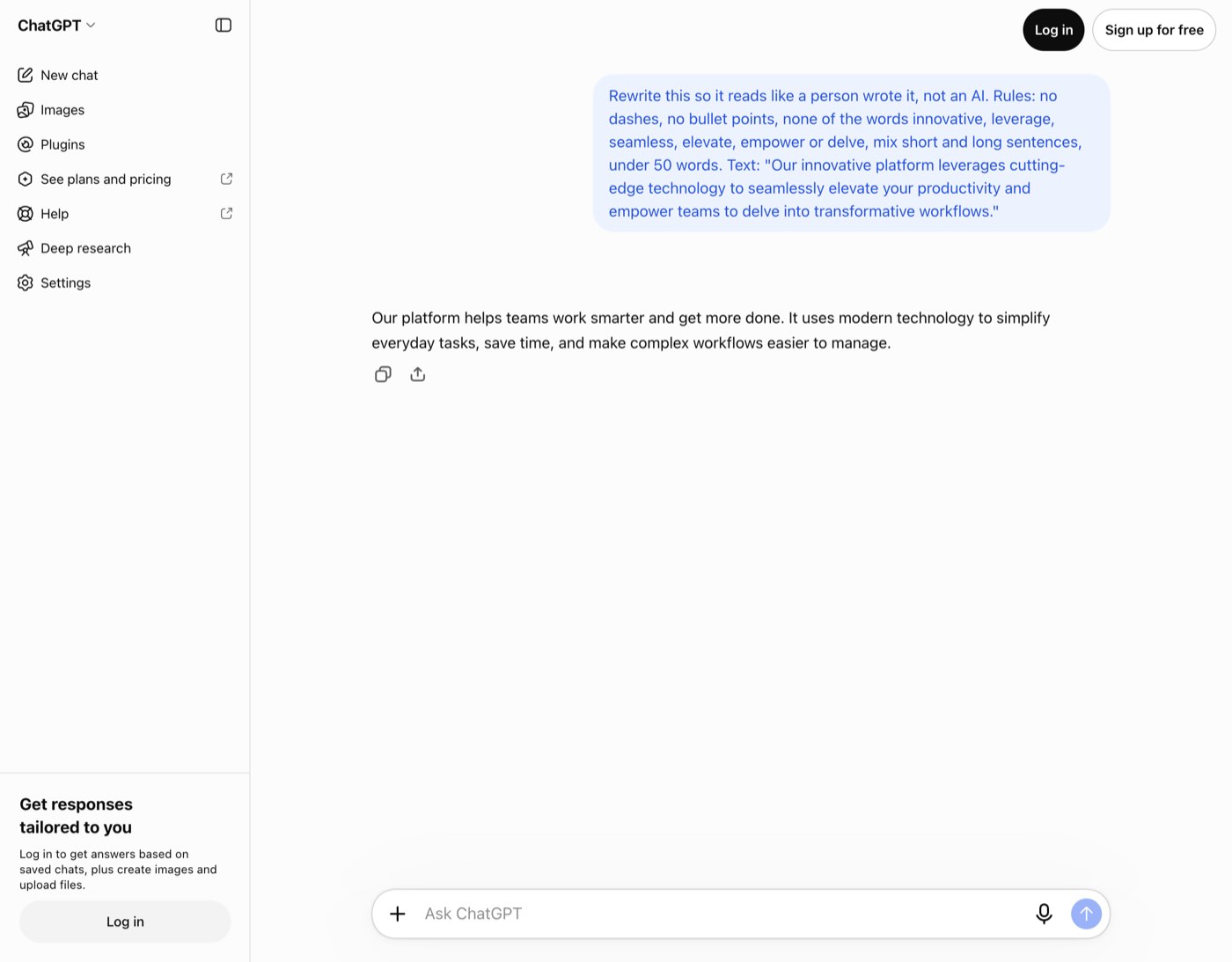
The write-like-a-human prompt in ChatGPT on October 26, 2026: two plain sentences, every rule followed.
What does not work is "make it sound human" on its own. That is the fluffy instruction OpenAI's API article warns against. Say who is writing, who is reading, how long it should be, and give one sentence of your own as the sample.
ChatGPT prompts for photos: the 1980s trend, caricatures and editing
A ChatGPT prompt for photo editing follows the same four parts, with one extra rule: say what must not change. Images need a signed-in account, and the Free plan's image creation is "limited", per OpenAI's pricing page. Since the ChatGPT Images 2.5 release of 8 September 2026, you can also "share the prompt for a generated image so others can create their own version". That is how the 1980s trend spread. On 26 October 2026 the signed-out chatgpt.com homepage still carried a banner for it: "What's your '80s look? Big hair. A whole new era."
That trend, which filled Instagram in September 2026, has an official 1980s photo prompt. ChatGPT's maker suggested this wording, NewsBytes reported on 10 September 2026: "Using my uploaded photo, show me what I would have looked like around 1985. Preserve my identity, facial features, skin tone, age, and recognizable appearance. Reimagine my hair, clothing, accessories, and surroundings with bold, unmistakably mid-1980s styling: expressive silhouettes, statement accessories, layered details, distinctive colors, and textures. Make it feel like genuine 1985 photograph with analog grain, faded color, direct flash, and subtle softness. Add a period-accurate 1980s red-orange date stamp in the lower corner. No modern objects or text."
Notice the shape. Half the prompt is boundaries: identity, skin tone and age stay fixed, modern objects are banned. OpenAI's shorter example, "Show me what I would look like if I was in the '80s", was shared under the name Neon 80s Portrait, per t2online's report of 9 September 2026. The Free Press Journal added Indian variants two days later, from a 1980s Bollywood portrait to a wedding-album throwback, after Kiara Advani, Virat Kohli and Narendra Modi posted their own.
The ChatGPT caricature prompt came first. In February 2026 the Free Press Journal described the viral prompt as "Create a caricature of me and my job based on everything you know about me". That wording pulls details from your chat history. If ChatGPT knows little about you, add them: "I am a nurse who mainly works with children", or "classic theme-park caricature, big head, smaller body". Upload a clear, front-facing photo.
Two cautions before you upload a face. OpenAI's pricing page states for every plan that "content is used to train our models", with an opt-out available in settings. And a prompt that edits a photo should list what stays the same, because the model will otherwise improve things you did not ask it to touch.
Does GPT-6 change how you write a ChatGPT prompt?
Not the formula, but three things changed in October 2026. First, the model: OpenAI's release notes of 7 October 2026 say "Plus, Pro, Business, and Enterprise use GPT-6 Sol; Free and Go use GPT-6 Luna", with Pro reasoning on GPT-6 Astra. Second, the format: with Intelligent UI, ChatGPT "can choose the format automatically", from tables and diagrams to a calculator in the chat. If you want plain text, say so in the prompt. A signed-out visitor sees no model name at all; our test chats showed only a "Writing" label on the longer replies.
Third, length. OpenAI Academy's guide says that since GPT-5 you can "consolidate context and related instructions into one request" instead of splitting them. The limit is the context window. OpenAI's pricing page lists an input maximum of about 12 pages of text on Free, 40 on Go and Plus, and 250 on Pro for the Instant models. Reasoning models on paid plans take far more.
The API article's first rule still applies: "use the latest model", because "newer models tend to be easier to prompt engineer". The practical upshot is that the role line and the step-by-step instructions matter less, while the boundaries and the output spec matter as much as ever.
Common ChatGPT prompt mistakes, from OpenAI's own list
OpenAI's API prompting article, updated in October 2026, pairs each mistake with a fix. The ones that cost everyday users the most:
Vague length words. "Fairly short, a few sentences only" becomes "Use a 3 to 5 sentence paragraph".
Only saying what not to do. Replace "do not ask for a password" with what to do instead, such as pointing to a help page.
Instruction buried after the text. Put the instruction first and separate the pasted material with """ marks.
No example of the format. Show one line of the output you want; the models "respond better when shown specific format requirements".
Everything in one go. OpenAI's help article on good prompts says to split complex work into focused prompts, and to iterate rather than restart.
Pasting secrets. The signed-out chatgpt.com footer says "Chats may be reviewed and used to improve our AI models", and the pricing page lists an opt-out, so keep passwords, client data and health records out of prompts.
ChatGPT prompts in India
India is one of the two countries where this exact search is most common, and ChatGPT is priced in rupees. OpenAI's pricing page, loaded from Delhi on 26 October 2026, lists ChatGPT Free at ₹0 with "unlimited text chats with GPT-6". Go is ₹399 a month, Plus ₹1,999 and Pro from ₹10,699. Go is the plan for "longer conversations" and, the page says, "may include ads". Plus adds ChatGPT Projects, scheduled tasks and custom GPTs, which is where saved prompts live.
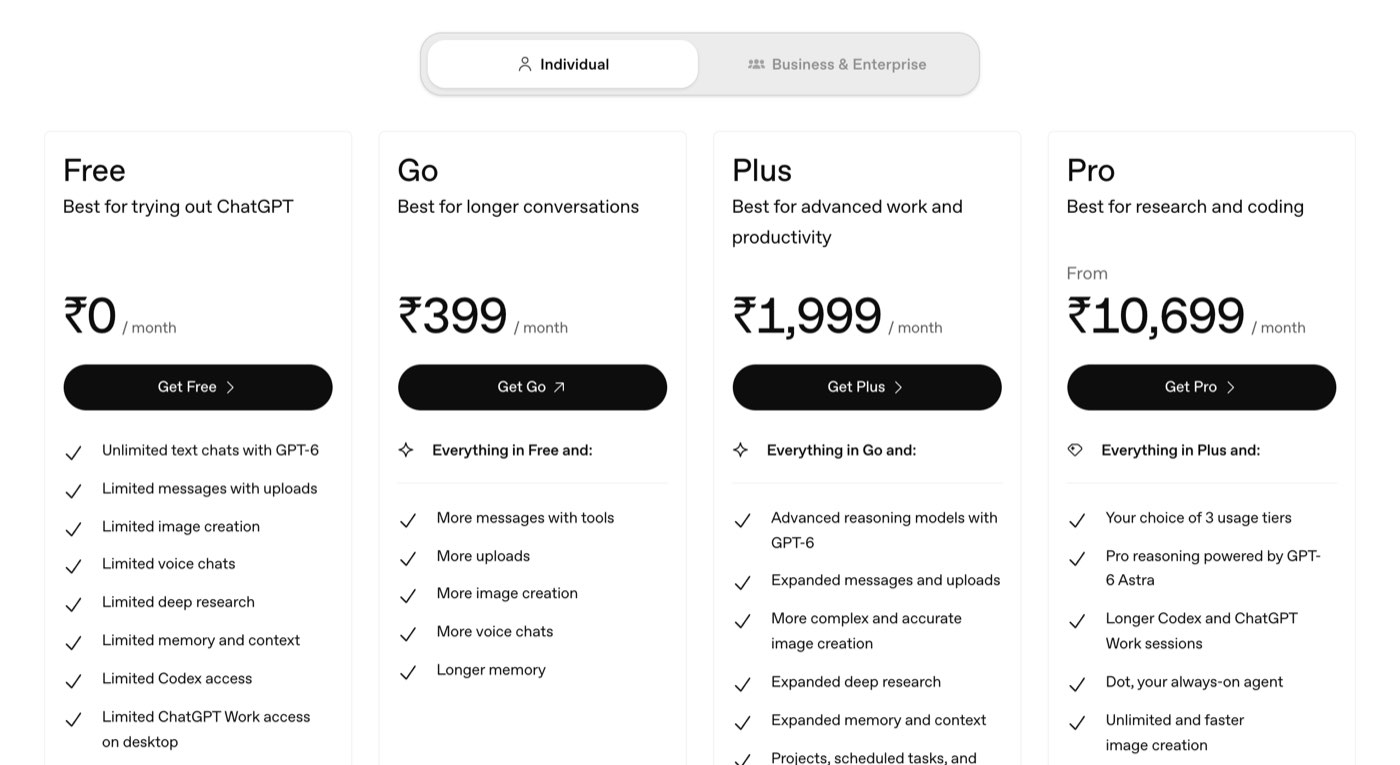
OpenAI's pricing page from Delhi on October 26, 2026: ₹0, ₹399, ₹1,999 and from ₹10,699 a month.
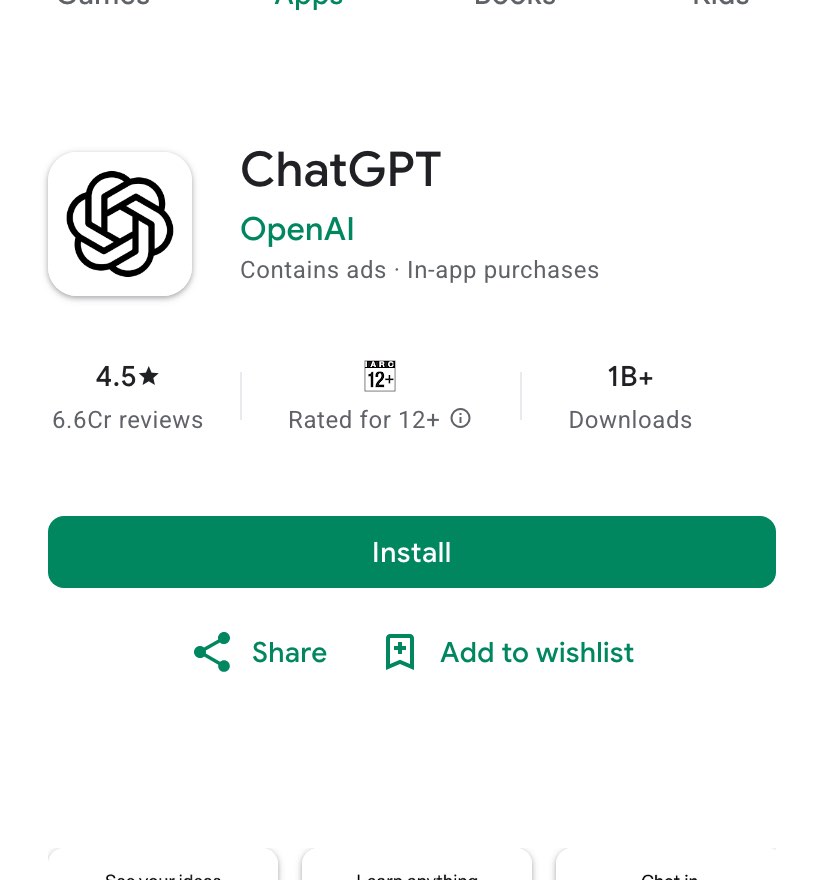
The ChatGPT app on Google Play India, October 26, 2026: 4.5 stars from 6.6 crore reviews and over a billion downloads.
The app is everywhere. On Google Play India it shows 4.5 stars from 6.6 crore reviews and more than a billion downloads, with the label "Contains ads". On India's App Store it is rated 4.7 from about 2.19 million ratings, per Apple's search API on 26 October 2026. ChatGPT Voice added Hindi voices on 15 October 2026, per the release notes, and typed prompts in Hindi or Hinglish follow the same four parts as English ones.
How this was checked
Every quotation above was read on 26 October 2026 from a home broadband connection in Delhi. The formula and its wording come from OpenAI's ChatGPT Learn guide, its two help-centre prompting articles and its OpenAI Academy resource. Model names, plan contents and the signed-out composer come from OpenAI's release notes and its pricing page as it loads from India. The trend prompts come from the September 2026 and February 2026 reports linked beside each one, and the app figures from Google Play India and Apple's App Store search API.
The prompt test used a Playwright script that opens chatgpt.com in a fresh Chromium profile with no login. It identifies itself as an ordinary desktop Chrome, because the site turns away browsers that announce themselves as automated. It sent four prompts in four new chats and saved a screenshot of each. The replies quoted above were transcribed from those screenshots, which are kept with the script, its README and the results file in this article's draft. We did not time the replies. For another tool tested without an account, see our Gemini AI guide.
Frequently asked questions
What is a ChatGPT prompt?
The question, instruction or goal you give ChatGPT, in text, voice, an image or a file. OpenAI's help centre calls it "a text input that initiates a conversation or triggers a response from the model".
How do I write a good ChatGPT prompt?
State the goal, add the context, name the output and set boundaries, per OpenAI's Learn guide. Add an example of the format when it matters, then refine with follow-ups instead of starting over.
Can you give me a prompt for ChatGPT?
Yes: "Write me a prompt I can paste into ChatGPT to get [result]. Give only the prompt." ChatGPT writes it, and the 40 prompts above cover work, study, code, money, job hunting and photos.
What are the best ChatGPT prompts?
The ones that state a goal, give context, name the output and set a boundary. In our test in ChatGPT on 26 October 2026, that shape got exactly the format and facts asked for, while a one-line prompt invented features. The 40 prompts above all follow it.
Is there a ChatGPT prompt generator?
Three kinds. Ask ChatGPT itself, use a free web generator such as PrompTessor, or paste the Reddit "prompt engineer" loop above so ChatGPT interviews you until the prompt is right.
How long can a ChatGPT prompt be?
About 12 pages of text on the Free plan, 40 on Go and Plus and 250 on Pro for the Instant models, per OpenAI's pricing page on 26 October 2026. Reasoning models on paid plans take far more.
Do I need an account to use a prompt in ChatGPT?
Not for a text chat on the web. We sent four prompts signed out on 26 October 2026, and OpenAI's release notes describe a signed-out composer since August 2026. Images, file uploads, memory and chat history need a free account.
What is the 1980s photo prompt for ChatGPT?
OpenAI's suggested wording starts "Using my uploaded photo, show me what I would have looked like around 1985", as NewsBytes reported in September 2026. It tells the model to preserve identity, skin tone and age. The full prompt is in the photo section above.
How do I make ChatGPT write like a human?
Paste a sample of your own writing and ask it to describe the style, as the Penn Libraries guide suggests. Then have it write in that style with your banned words and a length limit. Avoid the bare instruction "sound human".
Does the same prompt work in Gemini or Claude?
Mostly, yes. The four parts are not ChatGPT-specific, and Google's own guidance for Gemini asks for the same clarity. Our Gemini AI guide covers where its free plan differs, including answering without an account.
The Writeouts editorial desk for AI: plain-English explainers and comparisons of models, agents and automation tools, published under our editorial standards. From the Writeouts editorial team.
See everything by @ai-deskEdited by Rajat Chauhan. How articles here are written and edited.
0 comments
Sign in to join the discussion.
Loading comments…