What is machine learning used for? Machine learning is used to make predictions from examples. Which email is spam, which film you will watch next, how long a drive will take, whether a face matches, what tomorrow's weather will be. Every example in this article is a working system, named, dated and tied to its own documentation.
We read each source on 24 November 2026 from Delhi. They are Google's own pages on Gmail, Maps, Translate, weather and floods, Netflix's and YouTube's explanations of their recommendations, Apple's Face ID security note, and the US FDA's list of AI-enabled medical devices. Also Waymo's safety data, the Reserve Bank of India's innovation hub, UIDAI's face-authentication app, and OpenAI's notes on how ChatGPT was trained and why it still makes things up. Where a figure comes from the company that runs the system, we say so.
Use | Who runs it | What the model learns from | Kind of learning |
|---|---|---|---|
Spam and phishing filter | Google (Gmail) | Billions of messages users and systems have marked as junk | Supervised |
Film and video recommendations | Netflix, YouTube | What people watched, finished, rated and shared | Supervised, with learned embeddings |
Arrival times on a map | Google Maps with DeepMind | Live and historical traffic on road segments | Supervised (graph neural network) |
Face unlock | Apple (Face ID) | A depth map and infrared image of your face | Supervised, on the device |
Translation | Google Translate | Pairs of sentences and their human translations | Supervised (neural machine translation) |
Ten-day weather forecasts | Google DeepMind (GraphCast) | About 40 years of reanalysed weather data | Supervised |
River flood warnings | Google (Flood Hub) | Rainfall, watershed data and river gauges | Supervised (LSTM) |
Protein structure prediction | Google DeepMind and EMBL-EBI (AlphaFold) | Known protein structures and sequences | Supervised |
Reading scans in hospitals | 1,614 FDA-listed devices | Labelled X-rays, CT, MRI and ultrasound images | Supervised |
Driverless taxis | Waymo | Sensor data from hundreds of millions of miles | Supervised, plus simulation |
Catching money-mule bank accounts | Reserve Bank Innovation Hub (MuleHunter) | Transaction patterns across millions of accounts | Supervised and anomaly detection |
Aadhaar face authentication | UIDAI (AadhaarFaceRD) | Face images matched against the enrolled record | Supervised, with liveness checks |
Chatbots such as ChatGPT | OpenAI | Internet text, then human-written and human-ranked answers | Self-supervised, then reinforcement learning from human feedback |
Classifying your own text | You, in 20 lines of Python | 16 example messages | Supervised (run below) |
What is machine learning?
Machine learning is a way of programming a computer by giving it examples instead of rules. The program, called a model, adjusts its own internal numbers until its output on the examples is right, then applies what it found to new cases. Tom Mitchell's textbook puts it in one line: machine learning is "the study of computer algorithms that improve automatically through experience" (Carnegie Mellon's page for the book).
The idea is old. Arthur Samuel's 1959 paper in the IBM Journal of Research and Development, "Some Studies in Machine Learning Using the Game of Checkers", reported a result. "A computer can be programmed so that it will learn to play a better game of checkers than can be played by the person who wrote the program." That sentence still describes the point: the programmer does not know the answer, the program finds it from data.
A spam filter is the plain case. Nobody can write down every rule that separates junk mail from real mail. But you can show a model millions of messages that people marked as spam and millions they kept, and let it work out which words, senders and patterns go with which label. If "what is an algorithm" is new to you, our explainer on what a data structure is covers the ground that machine learning builds on.
What is the main purpose of machine learning?
The main purpose of machine learning is prediction where rules are too hard to write by hand. It turns past examples into a function that scores new ones: spam or not, buy or not, how many minutes, which word comes next. Everything in the table above is one of those predictions, dressed in a product.
Three families cover almost all of it. Google's Machine Learning Crash Course describes them this way:
Supervised learning. The examples come with the right answer attached (this email is spam, this scan shows a fracture, this trip took 23 minutes). The model learns to reproduce the answers. Most of the systems in this article are supervised.
Unsupervised learning. No answers are attached. The model finds structure on its own: customers who behave alike, transactions that look unlike the rest. Fraud and anomaly detection lean on this.
Reinforcement learning. The model acts, gets a reward or a penalty, and adjusts. It trained the chess and Go programs, and a form of it, with people as the judges, is how ChatGPT was taught to answer politely.
Deep learning is not a fourth family. It is a way of building the model, as a neural network with many layers, and it can be used in any of the three. Most of the examples below are deep learning.
What is machine learning used for? 14 real examples
Each entry says what the system does, which company or agency runs it, what we could verify from its own documentation, and what kind of learning it is.
1. Filtering spam and phishing in Gmail
Google's Safety Center page for Gmail says Gmail "blocks more than 99.9% of spam, phishing attempts, and malware from reaching you". It adds that the spam filtering blocks "nearly 10 million spam emails every minute". The filter is a classifier: every message gets a score, and the score comes from models trained on what users and Google's systems have marked as junk before. Supervised learning, at the largest scale most people meet daily.
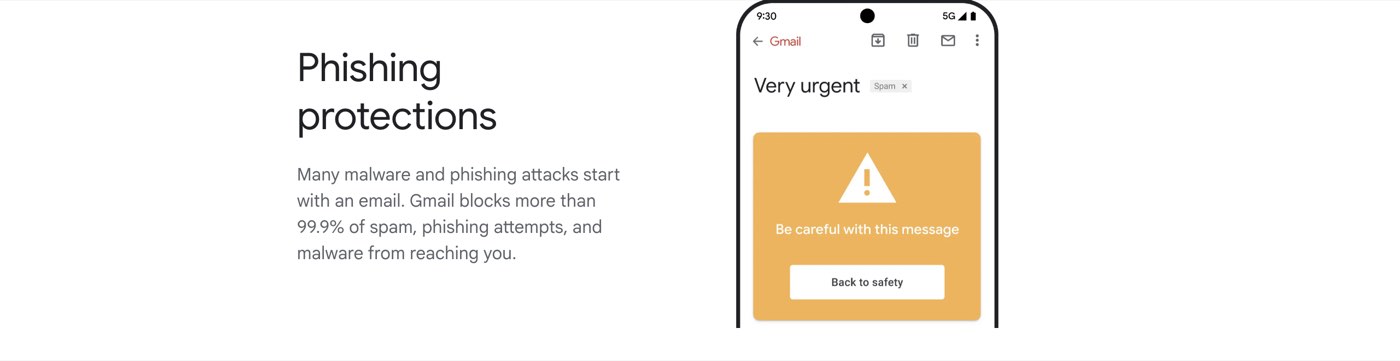
Google's Safety Center page for Gmail, read on 24 November 2026. The 99.9% figure is Google's own.
2. Recommending what to watch on Netflix and YouTube
Netflix's help article "How Netflix's recommendations system works" lists what its models take in. What you watched and rated, members with similar tastes, the title's genre and cast, the time of day, your languages and your device. It also states a limit worth knowing: "The recommendations system does not include demographic information (such as age or gender) as part of the decision making process."
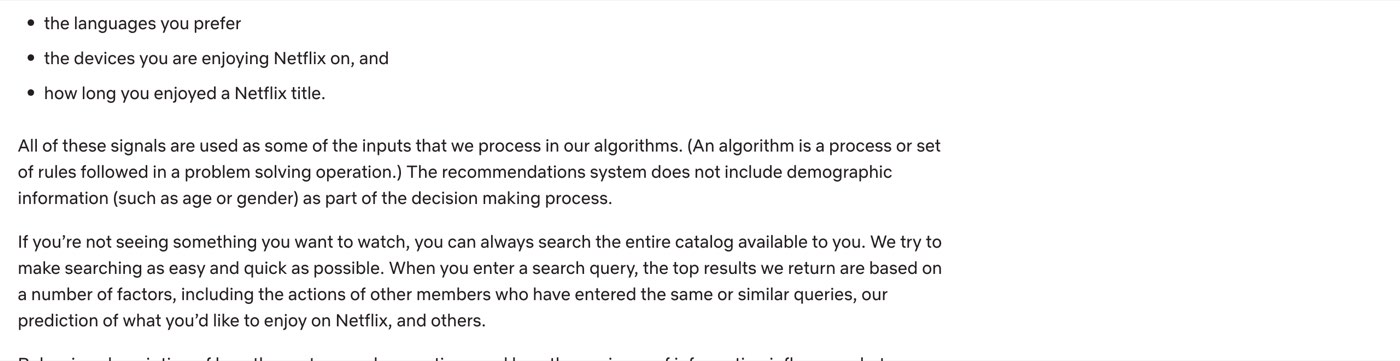
Netflix's help article on 24 November 2026: the inputs to its recommendation models, and the statement that age and gender are not among them.
YouTube's 2021 explanation, "On YouTube's recommendation system", is franker about the mechanics. Recommendations drive more viewing than subscriptions or search. The system learns from "over 80 billion pieces of information we call signals". When YouTube switched from counting clicks to counting watch time in 2011, views dropped 20% at once. And because not everyone answers the satisfaction surveys, YouTube "trained a machine learning model to predict potential survey responses for everyone", holding back some real answers to check the predictions. Both services are supervised learning on behaviour, with the labels being what people actually did next.
3. Predicting arrival times in Google Maps
A DeepMind post from September 2020, "Traffic prediction with advanced Graph Neural Networks", explains the part of Google Maps that guesses the traffic you have not reached yet. Live data shows the roads now; the model predicts them 10, 20 or 50 minutes ahead. DeepMind says the predictive ETAs were already accurate for over 97% of trips. Its graph neural network then cut the remaining error "by up to 50%" in Berlin, Jakarta, São Paulo, Sydney, Tokyo and Washington D.C. The road network is split into "Supersegments", and the model learns on those.

DeepMind's traffic-prediction post, read on 24 November 2026. The 50% figure is DeepMind's, for the cities it names.
4. Unlocking a phone with your face
Apple's support note "About Face ID advanced technology" describes a neural network running on the phone itself. The TrueDepth camera projects thousands of invisible dots to build a depth map and takes an infrared image. Then "a portion of your device's neural engine", inside the Secure Enclave, turns that into a mathematical representation and compares it with the enrolled one.
Apple states the false-match rate: "less than 1 in 1,000,000 with a single enrolled appearance", with only five failed attempts before the passcode is required. Separate "anti-spoofing neural networks" reject photographs and masks. The face data never leaves the chip, which is why this is a case of machine learning with no cloud involved.
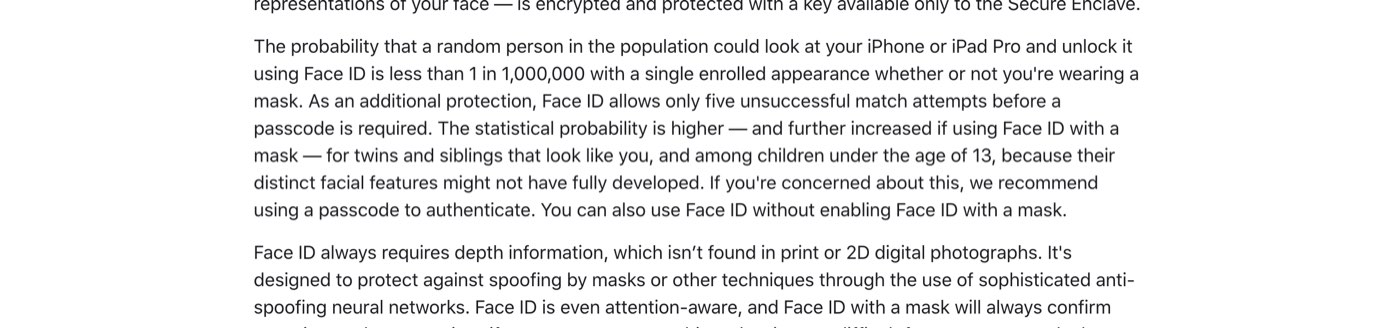
Apple's Face ID page on 24 November 2026: the 1 in 1,000,000 figure, the five-attempt limit, and the note that twins and children under 13 raise the odds.
5. Translating between languages
Google Translate moved to neural machine translation in 2016. A 2020 Google Research post describes the models since then. A transformer encoder with a recurrent decoder, trained on sentence pairs mined from the web, with a scoring step that filters out noisy pairs. The update raised quality by an average of 5 BLEU points across its 108 languages, and 7 for the 50 with the least data. The post is also honest about what still goes wrong. Overly literal output, mixed dialects, weak results on informal speech, and the odd "hallucination" when a model with little training data meets nonsense input.
This is natural language processing in its most used form. Supervised learning, where each training example is a sentence and its translation.
6. Forecasting the weather ten days out
GraphCast is DeepMind's weather model, described in a November 2023 post and a paper in Science. It was trained on about four decades of ECMWF's ERA5 reanalysis data. Given the weather now and six hours ago, it predicts six hours ahead, and rolls that forward to ten days. DeepMind reports it beat ECMWF's HRES system on more than 90% of 1,380 test targets. A 10-day forecast takes under a minute on one TPU v4 machine, against hours on a supercomputer for the conventional method.
The post's example: in September 2023 the public GraphCast run on ECMWF's site put Hurricane Lee's landfall in Nova Scotia about nine days ahead, three days before the traditional forecasts settled on it.
7. Warning people about river floods
Google's flood work began in India. A 2024 Google Research post on its Nature paper says the 2018 pilot ran in the Ganges-Brahmaputra basin. The models are LSTMs, a kind of neural network for sequences, fed with rainfall and watershed data. The post states that Flood Hub now gives "real-time river forecasts up to seven days in advance, covering river reaches across over 80 countries". That includes places with no river gauges at all, which is the problem the paper set out to solve.

Google Research on 24 November 2026: seven-day river forecasts in more than 80 countries, with the model evaluation done with ECMWF.
8. Predicting the shape of proteins
AlphaFold predicts a protein's three-dimensional structure from its amino-acid sequence. The AlphaFold Protein Structure Database, run by DeepMind with EMBL's European Bioinformatics Institute, said on 24 November 2026 that it "provides open access to over 260 million protein structure predictions". The site also notes the system was the top-ranked method at the CASP14 assessment and lists its limitations. Before it, a single structure could take a laboratory years. The model learned from the structures that laboratories had already solved: supervised learning with decades of other people's experiments as the training set.
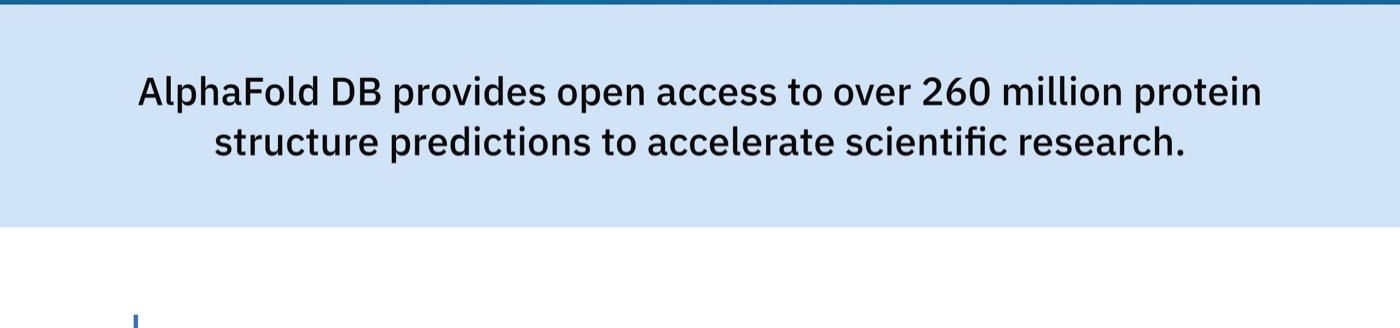
The AlphaFold database on 24 November 2026.
9. Reading X-rays, CT and ultrasound scans
The US Food and Drug Administration keeps a public list of AI-enabled medical devices it has authorised. The copy we read on 24 November 2026 had 1,614 entries, the newest with decision dates of 29 June 2026, and 1,230 of them were under the radiology panel. The next largest group, cardiovascular, had 165. These are products that flag a bleed on a CT scan, measure a heart chamber on ultrasound, or outline a tumour for radiotherapy. Nearly all are image processing models, supervised and trained on scans that radiologists labelled. The FDA list is the easiest place to check whether a claimed medical AI product has actually been cleared.
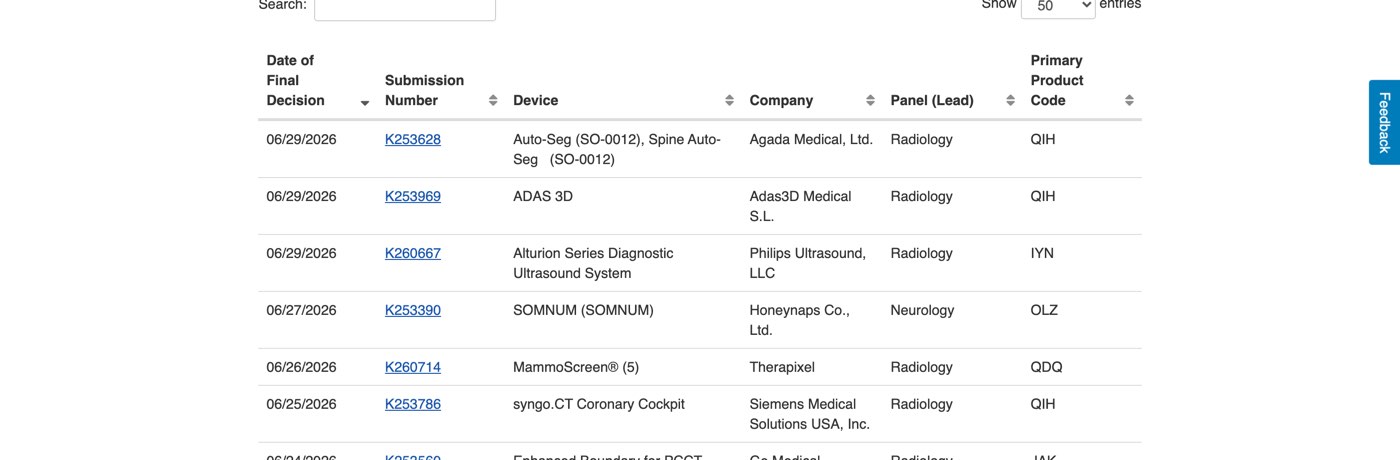
The FDA's device list on 24 November 2026, sorted by date of final decision. Most rows carry the radiology panel.
10. Driving a taxi with nobody at the wheel
Waymo publishes a safety impact dashboard built on crash reports it files with the US regulator. On 24 November 2026 it said that through June 2026 Waymo had driven 271.3 million rider-only miles with no human driver. Against a human-driver benchmark over the same distance in the same areas, it reported 95% fewer serious-injury crashes, 82% fewer injury-causing crashes and 93% fewer pedestrian crashes with injuries.
The numbers are Waymo's own analysis, and the page explains the method so others can redo it. The driving stack is many models: ones that find cars, people and lane lines in camera, lidar and radar data, and ones that predict what each road user will do next.
11. Catching money-mule accounts in Indian banks
The Reserve Bank Innovation Hub, a subsidiary of the Reserve Bank of India, built MuleHunter to find bank accounts that criminals rent or hijack to move stolen money. Its project page describes a model that "learns and spots specific patterns of mule account activity across millions of transactions". It flags accounts in "near real-time" where rule-based systems took weeks. The page claims accuracy above 90% in many cases, with 75% fewer false positives. Those are the hub's figures, not an independent test. The method mixes supervised learning on known mule accounts with anomaly detection on everything else, and it runs inside each bank, so no transaction data leaves.
12. Authenticating with a face against Aadhaar
UIDAI's AadhaarFaceRD app is the face-matching component behind Aadhaar face authentication. On 24 November 2026 its Google Play listing showed more than 10 crore downloads and a 4.0 rating from 7.49 lakh reviews. The app has no screen of its own. A bank, a ration shop's point-of-sale app or a telecom operator calls it when a person needs to be verified. It captures the face, checks that it is a live person and not a photograph, and sends the result for matching. Face matching and liveness detection are both learned models.

AadhaarFaceRD on Google Play (India), 24 November 2026.
13. Answering questions as a chatbot
ChatGPT is machine learning twice over. OpenAI's launch note from November 2022 says it was "fine-tuned from a model in the GPT-3.5 series", which was first trained to predict the next word in a vast body of text. OpenAI then trained it "using Reinforcement Learning from Human Feedback (RLHF)": human trainers wrote example conversations, ranked the model's candidate replies, and a reward model learned from those rankings. The first step is self-supervised learning, the second is reinforcement learning with people as the judges. See our guides to writing ChatGPT prompts and to Gemini for how the finished products behave.
14. A spam filter you can train yourself in 20 lines
To show that the core idea fits on a screen, we trained a tiny spam filter on 16 made-up messages and asked it about four it had never seen. This is the whole program, run as printed with Python 3.9.13 and scikit-learn 1.0.2 on an Apple M2 Mac on 24 November 2026:
from sklearn.feature_extraction.text import CountVectorizer
from sklearn.naive_bayes import MultinomialNB

messages = [
    "win a free prize now", "claim your free gift today", "you have won cash",
    "urgent: verify your account to claim reward", "free entry in a lucky draw",
    "congratulations you won a free holiday", "lowest price pills buy now",
    "act now limited offer free money",
    "meeting moved to 3 pm tomorrow", "can you send the report by friday",
    "lunch at the usual place?", "the invoice for october is attached",
    "reminder: dentist appointment on monday", "thanks for the notes from class",
    "mom called, call her back", "project review is at 11 in room 4",
]
labels = ["spam"] * 8 + ["not spam"] * 8

vectorizer = CountVectorizer()          # turns each message into word counts
X = vectorizer.fit_transform(messages)  # 16 rows, one column per distinct word
model = MultinomialNB().fit(X, labels)  # learns which words go with which label

new = ["free cash prize, claim now", "are we still on for lunch friday?",
       "your account needs urgent verification", "notes from today's meeting attached"]
for text, guess in zip(new, model.predict(vectorizer.transform(new))):
    print(f"{guess:>8}  <-  {text}")
print("distinct words learned:", len(vectorizer.vocabulary_))
The output:
    spam  <-  free cash prize, claim now
not spam  <-  are we still on for lunch friday?
    spam  <-  your account needs urgent verification
not spam  <-  notes from today's meeting attached
distinct words learned: 68
Nobody wrote a rule that says "urgent" means spam. The model counted that "urgent", "free", "claim" and "account" appeared in the spam examples and not the others, and applied that to the new text. Gmail's filter does the same thing with billions of messages and a far larger model. This is the smallest honest answer to "what is machine learning used for": turning labelled examples into a decision you did not have to code.
Is ML full of coding?
No. Using a trained model needs no code at all; every example above is used through an app, a car or a camera. Building one needs some code, but less than people expect: the spam filter above is 20 lines, and the libraries do the mathematics. What takes the time is the data. Collecting it, labelling it, cleaning it and checking the model does not cheat is most of the job. Google's own introductory course spends its first lessons on framing the problem and preparing data before any model appears.
The code that is there is mostly Python, with the data often pulled from a database first, so the SQL cheat sheet is a better first step than a calculus textbook. Tools such as n8n let you call a trained model from a workflow with no code of your own, by sending it data through an API.
Is ChatGPT machine learning?
Yes. ChatGPT is a large language model, and a language model is a machine learning model trained to predict the next word. OpenAI's launch note says ChatGPT was fine-tuned from GPT-3.5 using supervised fine-tuning and reinforcement learning from human feedback. The same is true of Gemini, Claude and Llama. What makes them feel different from a spam filter is scale and the shape of the output: the prediction is a word, repeated thousands of times, rather than a single label.
What is the difference between ML and AI?
Artificial intelligence is the goal: a machine that does things we would call intelligent if a person did them. Machine learning is one way to get there, by learning from data rather than following hand-written rules. A chess program from the 1990s that searched moves with rules written by its programmers was AI without machine learning. A spam filter trained on labelled mail is machine learning, and most people would also call it AI. Since about 2012 nearly every AI system that matters has been built with machine learning, which is why the two words are used as one.
Artificial intelligence | Machine learning | Deep learning | |
|---|---|---|---|
What it is | The broad aim: machines doing tasks that need judgment | Programs that learn the task from examples | Machine learning built from neural networks with many layers |
Needs data? | Not necessarily (rule-based systems are AI) | Yes, that is the point | Yes, usually a great deal |
Example | A 1990s chess engine with hand-written evaluation rules | The 20-line spam filter above | GraphCast, AlphaFold, Face ID, ChatGPT |
Where machine learning fails
A model is only as good as its examples, and it has no idea what it does not know. Three documented failures show the pattern.
Google Flu Trends. Google's model estimated flu levels from search queries. A March 2014 article in Science by Lazer, Kennedy, King and Vespignani records that in February 2013 it was "predicting more than double the proportion of doctor visits for influenza-like illness" that the CDC measured. Predicting the CDC's figure was its entire job. The authors' name for the cause was "big data hubris": the model learned patterns in searches that drifted away from the disease.
Face recognition across demographics. The US National Institute of Standards and Technology tested 189 face-recognition algorithms from 99 developers for its December 2019 report on demographic effects. It found that "the majority of face recognition algorithms exhibit demographic differentials". That means error rates that change with the subject's race, age or sex. The models had learned from unbalanced data.
Chatbots that make things up. OpenAI's September 2025 note "Why language models hallucinate" gives its own numbers. On one test, an older o4-mini model gave a wrong answer 75% of the time and declined to answer 1% of the time. The newer gpt-5-thinking-mini was wrong 26% of the time and declined 52% of the time. OpenAI's explanation is that training and benchmarks reward guessing over saying "I don't know".
The lesson across all three is the same. Machine learning is used wherever there is a lot of representative, labelled history and the cost of an occasional wrong prediction is bearable. It is a poor fit where the past does not predict the future, where the data is thin or skewed, or where one wrong answer is unacceptable without a person checking it.
Machine learning in India
Three of the examples above run at national scale in India. Google's flood forecasting started with a 2018 pilot in the Ganges-Brahmaputra basin before it covered 80 countries. UIDAI's face authentication app has passed 10 crore downloads on Google Play. And the RBI's innovation hub offers MuleHunter to banks to spot mule accounts behind "digital arrest" and investment scams. Add the Indian-language translation and speech models that the government's Bhashini programme, the National Language Translation Mission, makes available to developers. Most Indian readers have used four machine learning systems before lunch, through UPI, Aadhaar, Maps and a phone keyboard.
How this was checked
Every source linked above was read on 24 November 2026 from a home broadband connection in Delhi, and the screenshots were taken the same day from the live pages. Figures attributed to Google, Netflix, YouTube, Apple, DeepMind, Waymo, the Reserve Bank Innovation Hub and OpenAI are those organisations' own statements about their own systems. We did not test them independently, and we say so where it matters. The FDA count comes from the list as served that day, with the radiology and cardiovascular figures counted from its rows. The 20-line spam filter was run exactly as printed; the script and its output are kept with the draft.
Frequently asked questions
What is machine learning used for in everyday life?
Spam filters, the order of your social feed, and the films and videos you are recommended. The arrival time on your map, face unlock on your phone, translation and the weather forecast. Fraud checks on a card or UPI payment, and the chatbot you ask questions. Each of these is a model trained on past examples.
What are the three types of machine learning?
Supervised learning, where examples come with the right answer; unsupervised learning, where the model finds structure without answers; and reinforcement learning, where the model acts and is rewarded or penalised. Deep learning is a way of building models with neural networks and can be used in all three.
Is machine learning the same as AI?
No. AI is the broad aim of machines doing tasks that need judgment; machine learning is the method of learning those tasks from data. Nearly all current AI is built with machine learning, so the terms are used together.
Where is machine learning used in India?
Aadhaar face authentication, where UIDAI's AadhaarFaceRD app has over 10 crore downloads. MuleHunter from the RBI's innovation hub, for spotting money-mule bank accounts. Google's flood forecasts, which began in the Ganges-Brahmaputra basin in 2018. And the Bhashini translation and speech models for Indian languages.
Can machine learning be wrong?
Yes, and in documented ways. Google Flu Trends overestimated flu by more than double in 2013. NIST found demographic differences in most face-recognition algorithms it tested in 2019. OpenAI's own 2025 figures show chatbots still give wrong answers a quarter of the time on hard factual tests. A model only knows the patterns in its examples.
The Writeouts editorial desk for AI: plain-English explainers and comparisons of models, agents and automation tools, published under our editorial standards. From the Writeouts editorial team.
See everything by @ai-deskEdited by Rajat Chauhan. How articles here are written and edited.
0 comments
Sign in to join the discussion.
Loading comments…